|
|
Places in Spain -
Valencia, region and
city of Spain
|
The region
of
Valencia is located
in the
east of
Spain and
is well
known for
its
ceramics,
fans, oranges and
wicker-work.
The
Valencian
coast
consists
of many
beautiful
resorts
with
golden
beaches
and towns
full of history.
Inland,
the soil
is fertile
and the
region has
adopted
the
nickname
'the
bread-basket
of Spain'. Valcencia is rich with history, natural beauty and culture.
|
| Wherever you go in the region of Valencia you are bound to come across plantations of oranges. In parts of the region, the orange trees are surrounded by olive trees, almond trees and in some areas, by rice paddy fields. |
|
|
|
| |
| |
|
Valencia city is well
connected
within the
road
network,
namely by
the N340
to
Barcelona and
Alicante,
the NIII
to
Castilla
La Mancha and Madrid and the A7
motorway
which
links
Valencia
to the
European
network.
Getting around Valencia
Valencia
is
one of
Spain's
most
densely
populated
cities and is always busy. It's also a very popular tourist destination. As
you enter
the city
of
Valencia,
the roads
become
somewhat
confusing
and can be
hard work.
Once in
the city,
expect to
spend time
in traffic
and
parking can be
very
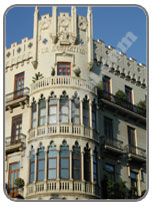
difficult. The inner city of Valencia is not as large as you might first imagine and walking is the best way to get around. We found that parking near the City of Sciences was a good idea then walk into the historic centre (2km). Valencia has a city bike rental service, www.valenciabikes.com. You can take a guided tour of Valencia by bike at 10am every day. (Tel 963 851 740). The cycle rental system in Valencia has parks all over the city where you can collect/deposit a cycle. When walking round you have to watch out for bikes as they're everywhere. There were a few horse and carriages near the Plaza de la Virgen, offering trips at 30€ a go. Walking tours are a great way to learn about Valencia. At around 15€ per adult and lasting 2 hours, the historic centre walk rund at 11am every Sunday. There are other walks to choose from too. 4 languages available. |
 |
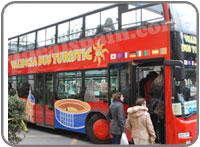
The tour bus in Valencia is another way to get around although we found it not as good as other cities. The bus runs on two routes (red and blue). We thought the bus was a little fast and there weren't many stops. You do get to see the most important sights but only as you are travelling along. The bus was advertised as an 'open-top' bus but we were unfortunate that the driver we had saw a grey cloud and thought he'd put the roof over, making photography and video impossible. No amount of asking would make him change his mind. At 15€ per person, it was hardly worth it. We got on much better when we decided to walk round.
The Valencia Tourist Card may be an option if you plan on travelling a lot as it offers free, unlimited public transport and discounts on various attractions. Cards last 24/48 or 72 hours. Purchase from any tourist office and hotels. Tel 900 701 818.
Prices: 24hour 12€, 48hour 18€ and 72hour 22€. |
|
What to see in Valencia city
Valencia was founded by the Roman Empire in 138BC and has been a thriving city ever since. As such, there's no wonder that there's so much to see in the city. There's a mltitude of historic buildings that remain from every era. Art Deco stands happily alongside classical, Baroque and Renaissance buildings. There's a unique and attractive buliding on every corner. |
| |
To see the
historical
centre of
Valencia
you would
do well to
make your
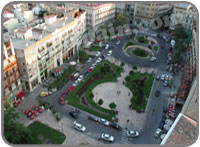
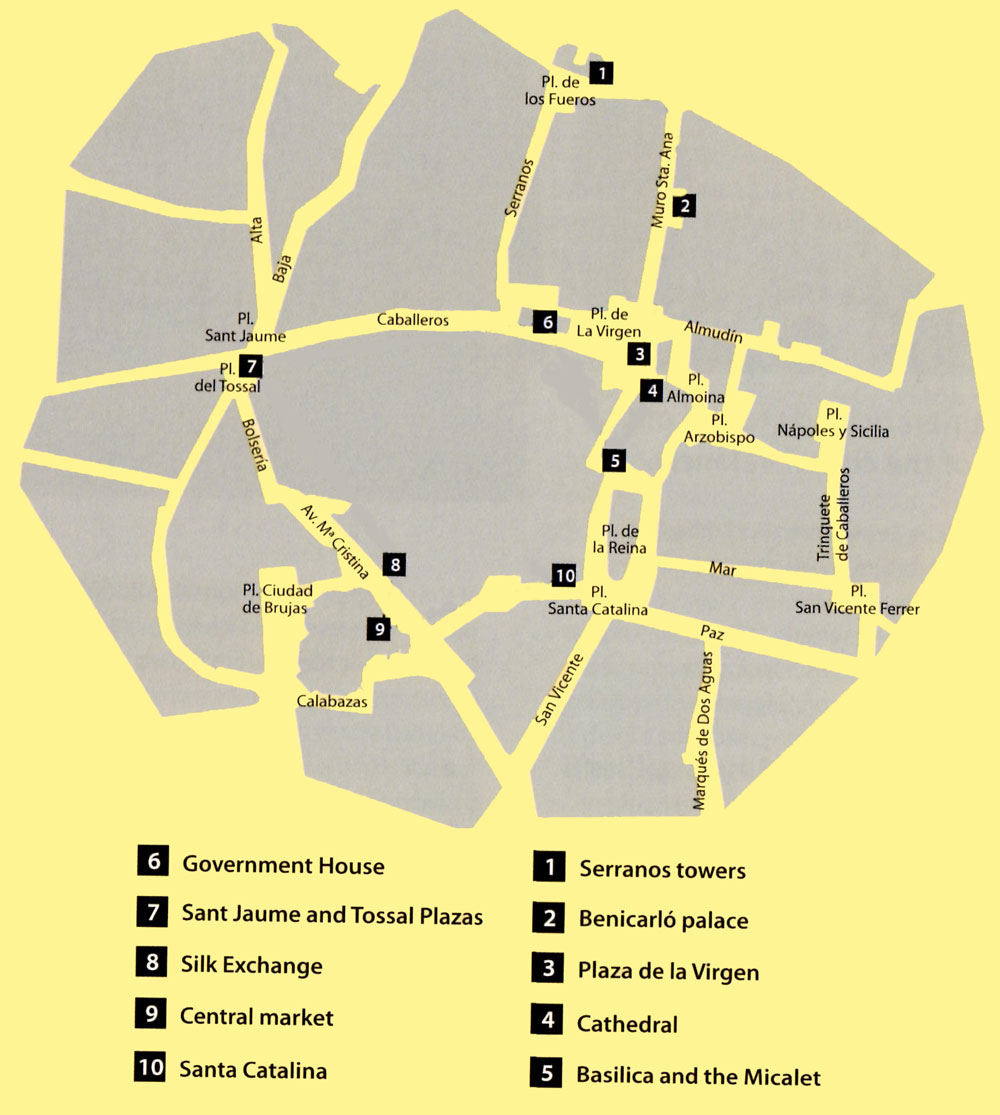
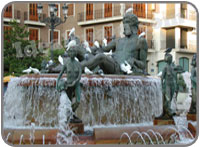
way to the Plaza de
la Virgen (pictured
right).
This is
the heart
of old
Valencia
and once
the
location
for the
Roman
Forum.
This area
was once
surrounded like an
island by
the
tributaries
of the
River
Turia.
This is
now
illustrated
by the
fountain
in the
square
which
consists
of a
central
figure
representing
the river,
surrounded
by seven
maidens,
representing
the
tributaries.
Today the
square is
a popular
resting
place and
is
constantly
full of
life.
Around
this square you
will find
many
important
buildings
such as
the Cathedral,
the Basilica and the Palacio de
la
Generalitat. |
|
| |
| The Plaza de la Virgen has a handful of cafes around the edge and it's a nice place to sit in the mid-day sun. Snacks and drinks are quite good value. |
|
| |
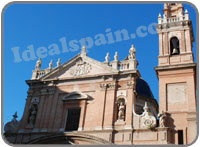
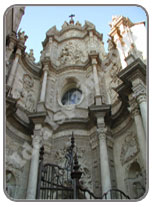
The Cathedral (pictured
right),
stands on
ground
once
occupied
by a
Muslim
Mosque and
an earlier
church.
The
current
building
is of
Gothic-Cistercian
design and
dates from
1262. It
wasn't
actually
completed
until the
18th
century.
This is
illustrated
by the
many
differing
designs
incorporated. There are three doors, all in different styles.
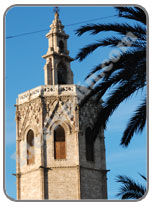
There is
an
imposing
tower
which can
be climbed
using the
200 steps.
You will
be
rewarded
at the top
with
spectacular
panoramic
views of
the city.
Purchase a
ticket
inside the
Cathedral
(costs
approx.
1.50€).
You can
also
purchase
books and
city
guides
inside the
Cathedral.
Watch out for gypsies peddling 'lucky' heather and telling fortunes in this area, although there is usually a high police prescence. |
|
| |
| Pictured
right is
the view
from the
tower over
the
beautifully
laid out
gardens.
Next to
the
Cathedral
you will
find the Basilica
de la
Virgen,
a temple
dedicated
to the
Valencian
Patroness.
At the
altar you
will find
a
beautiful
Gothic
statue.
The
Basilica
was built
between
1652 and
1667
following
a style
that is
considered
Pre-baroque.
The
building
is of oval
shape with
a
beautiful
painted
dome. It
is not of
great
proportions
and the
building
often
struggles
to cope
with the
number of
worshipers.
The City's
patron is
celebrated
on the
second
Sunday in
May when
the statue
is carried
to the
Cathedral
and back.
In a noisy
and
emotional
ceremony,
the statue
is passed
person to
person
without
touching
the
ground.
The
evening
procession
is
accompanied
by rose
petals
thrown
from the
balconies
and huge
floral
displays
being
built. |
|
| |
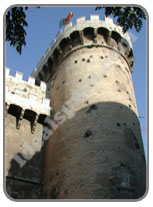
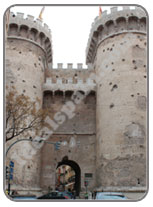
The city walls and gates
Pictured
right
is
another
important
construction
in
the
city.
The Torres
de
Quart is
the
work
of
Pere
Bonfill
and
dates
from
1444.
The
walls
are
pitted
with
holes
caused
by
French
shelling
during
the
War
of
Independence.
The
building
receives
its
name
because
it
was
once
the
gateway
to
Quart
de
Poblet,
an
old
settlement
on
the
Valencian
plains.
The towers
once
formed
part
of
the
old
city
walls,
destroyed
in
1865
to
allow
the
city
to
expand.
There
is
another
tower
in
Valencia,
called
the Torres
de
Serranos,
a
massive
and
bold
construction
opened
in
1400
and
still
standing
strong
to
this
day. The back of the towers is almost as interesting as the front, with its 6 arches in 3 tiers. The Valldigna Gate dates from 1440 and was opened by the Moors to allow access to the city. |
|
| |
| You can still walk through the gate of the Torres del Quart and you can pay a small entrance fee and climb to the top ramparts. |
|
| |
The Market District of Valencia
Another
area of
the city
worthy of
exploration
is the
market
district.
Here you
will find
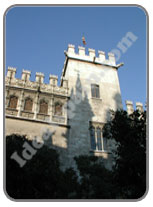
the Lonja,
pictured
right. This
ancient
building
was
constructed
as the
market or
exchange
for silks
and other
merchants.
The
building
has been
described
as one of
the best
civil
Gothic
buildings
in Europe,
a fact
recognised
by UNESCO
who
declared
the Lonja
'Heritage
of
Humanity',
the only
building
in
Valencia
to enjoy
this
title.
If you
have time
to explore
the Lonja
you will
be
rewarded
with
fantastic
architecture,
a
wonderful
plaza and
some of
the finest
ceilings
in Spain. The wooden panelling is gilded to a very high standard. Entry is free. |
|
|
Central Market in Valencia
In the
same area
you will
find the Central
Market.
Up until
1928 the
market was
held in
the
streets.
This
ceased
when the
new
building
was
completed.
Having a
surface
area of
more than
8,000
square
metres, it
is one of
the
largest in
Europe. It
houses
thousands
of stalls. It has a great main hall and a side hall dedicated to the selling of fish, both covered by glass domes. If you want to see the best of Valencian city life then this is the place to see it.
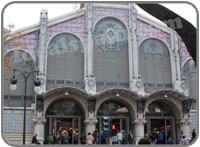
Pictured right is the central market building, always full of life. You could easily spend a few hours exploring it. There are some great places to grab a snack outside. You can sample tapas and typical Valencian dishes for very little money. |
|
|
|
The bullring in Valencia
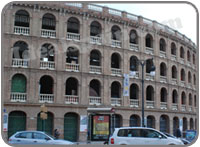
One of the most impressive bullrings in Spain, it has four tiers of arches and dates back 150 years. It is totally of red brick construction except the white balustrades. When it was built outside the city walls in 1860, it was the largest bullring in Spain. It seats over 16,000 people. You can find the bullring next to the huge railway station and it's about 10 minutes walk from the historic centre. |
|
| |
|
|
All in
all,
Valencia
is a
vibrant
city that
offers a
wealth of
plazas and
gardens in
which to
rest, a
wide
variety of
historical
buildings
to
explore,
dotted
around the
city and
blending
in with
the modern
constructions
and the
added
bonus of a
thriving
port,
marina and
long
beaches.
Holidays in Valencia
Valencia is the perfect destination for a city break. You can fly in to Valencia airport, take the Metro right into the city and find quality hotels at very attractive prices. Whatever you want from a city break, you will find it in the city of Valencia, day or night. If you're not exploring the city then chill out on the superb beach or take time out in the many museums and galleries.
|
|
| |
|
The modern part of Valencia
One of the
busiest
areas of
the city
is the Plaza
del
Ayuntamiento,
the new
vital
centre of
the city.
Here you
will find
the main
post
office and
the City
Council
building.
Not far
from here
you will
find the North
Station,
built in
1906,
arriving
here by
train you
will find
yourself
close to the
heart of
the
central
historical
centre.
The post office and other buildings in this part of Valencia are something to behold and totally different to the historical centre. The architecture is amazing. |
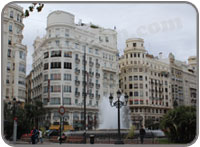
Modern Valencia
|
| |
|
Parks and gardens in Valencia
The Glorieta is one of the most important gardens in Valencia. Built by the French during their occupation of the city, the gardens are adorned with busts ans statues. The gardens were the first area in Valencia to have gas lighting in 1844. The Botanical Gardens are owned by the university and were established in the 19th century to serve the pharmaceutical industry and research. The old
riverbed
through
the city
has been
drained
and now
houses
various
sports
installations
and parks including the City of Arts and Sciences.
The Parque de Cabecera is one of the largest parks in Valencia. Others include Jardines del Real (Royal Gardens), Parque del Oeste (West Park) and Parque de Marxalenes, slightly north of the historic centre. The Royal Gardens are worthy of a visit. Here you can see the foundations of the historic moat that used to surround a palace. |
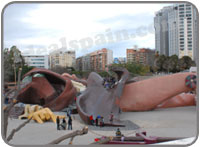
Gulliver play park in Valencia
|
| |
|
The largest park in Valencia runs through the dry river bed in which the City of Sciences stands. (See information and photo album here). Every section of the park, between bridges, is different from the last. There's a huge children's play area called 'Gulliver'. It's a moulded image of Gulliver and you are the tiny people. It's of huge proportions and is free of charge to use.
There are water features everywhere throughout the park as well as cycle routes, cycle hire, crazy golf and much more. |
|
| |
|
|
|
The coast of Valencia - The Costa Blanca (full feature here)
The Costa Blanca is one of the most popular destinations in Spain. The beaches are of golden sand and the resorts range from tiny fishing villages to the thriving resorts such as Benidorm and the city of Alicante.
|
The
coast of
Valencia city
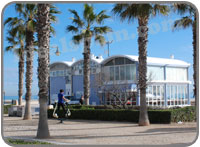
The main beach in Valencia is beautiful. It's very long and straight with a wide, tiled paseo. There are only a few beach bars and restaurants, lots of free parking and facilities on the beach include lifeguards and volleyball nets. The sand is spotlessly clean and golden in colour.
It may be
said that
the
Valencian
coast
consists
of just
one long
beach,
interrupted
only by a
few small
cliffs at
Cullera.
Of the 14
municipalities
of
Valencia,
only four
have a
coastal
strip. In
the north
you find El
Camp de
Morvedre with its
capital Sagunto.
The 57,000
inhabitants
are spread
between
the port
area and
the old
city. The
famous
castle
looks over
the old
city on a
hill, one
kilometre
long.
Sagunto
has a
Roman
theatre
dating
from the
2nd
century,
the first
such
monument
to receive
official
protection.
The upper
part of
the town
is very
picturesque
and should
be visited
on foot.
Explore
the narrow
streets in
the Jewish
Quarter.
There are
also several important
monasteries
and
churches
worthy of
a visit.
Along the
south
coast is La
Ribera
Baja,
an area
dominated
by its
capital, Sueca.
Described
as the
'Rice
Town' it
lies on a
huge
plain. Its
coastal
area is a
booming
tourist
centre.
The wide Bahia
de los
Naranjos (Orange
Grove Bay)
is one of
the most
attractive
areas
along the
whole
coast. The
population
swells to
over
100,000
during the
summer.
The
district
of Oliva marks the
boundary
of the
region in
the south.
It has a
magnificent
beach and
a great
deal of
history to
explore.
|
|
| |
Idealspain's visit to Valencia
We stayed in Valencia for three days in February 2011 and loved every moment. Valencia is a beautiful city full of history and lots to see. There's so much life and culture there. Valencia isn't the cheapest city we have been to but it certainly is one of the prettiest. We walked our feet off for three days but managed to see most things. Valencia is very clean and the traffic was surprisingly calm. From Valencia we drove south to the National Park in Albufera and through the rice fields to Cullera.
The Climate in Valencia
Valencia
enjoys a
typical
Mediterranean
climate
with hot
summers
and mild
winters. It very rarely gets extremely cold in Valencia and there are usually more than 200 clear skies in a year. The nicest thing about the weather in Valencia is that there are no real extremes. The variation of temperature is moderate.
Fiestas in Valencia
When it
comes to
festivals,
Valencia's
calendar
is full.
Much of
the city's
festivities
are marked
by huge
firework
displays
for which
the city
is famous. The majority of fiestas in Valencia are noisy.
The most
important
celebration
in Valencia is that of
the
Fallas
which
lasts a
whole week
from the
15th-19th
March. It's of such a size that it has been noted as of 'international importance'. It
coincides
with the
beginning
of spring and throws
Valencia
into an
explosion
of noise
and
colour.
More than
300 huge
Fallas
(works of
art) are
erected
around the
city. Each
is a
symbol of
malicious
criticism
and
sarcasm.
The climax
is on
March 19th
when the
Fallas are
burned at
midnight.
Easter
week (Semana
Santa) is also huge in Valencia. Another fiesta in Valencia worthy of mention is the Corpus Christi which dates back to the 14th century. Valencia was one of the first cities to celebrate Corpus Christi. You can see a diary of Valencian fiestas here.
The feria ground in Valencia is located in the Benimamet district and covers over 600,000 square metres which includes parking for 7,000 vehicles. The showground plays host to more than 40 events a year and handles more than 1.3 million people per year. The modern events centre stands out and is covered by a huge glass dome. Close by is the Luis Puig Cycle Track that also plays host to other large sporting events.

Video of Las Fallas
in Denia 2011 |

Lady of Forsaken
Denia, Fiesta 2011 |
|
|
Transport for Valencia city
The rail links with Valencia are excellent with a high speed link with Madrid and other major cities. The network of rail for Valencia covers more than 150km of track and 132 stations. Much of the rail in Valencia is underground, beneath the city. You can see Valencia on the open top tour bus, horse and carriage or by using the popular cycle hire scheme.
Entertainment and what to do in Valencia
Valencia
also
offers a
cultural
experience
never
forgotten.
There are
ample
theatres,
cinemas,
dance
halls and
entertainment
venues.
The
nightlife
pulsates
until the
early
hours of
the
morning.
There are
venues to
suit every
age and
taste.
|
|
|
|
The City of Arts and Sciences
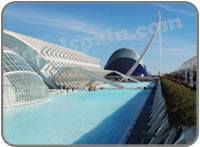
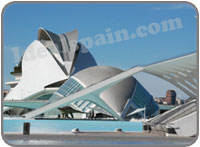
This has to be one of the jewels of Valcencia. The revolutionary facility cannot be totally seen in one day. Housed in a ground-breaking, modern building in the former river bed, it includes several facilities such as the 'Hemisferic', in the shape of the human eye, it houses a 900m dome onto which 3D films are screened. The key word in the Science Museum is 'touch'. The museum is designed to give a hands on experience. The Oceanografico has sea lions, whales and sharks and much more. More information: Tel 902 100 031 or see the website at www.cac.es
See information and photo album here
|
|
|
Bioparc Zoo
This zoo in Valencia has quite a unique design in so much as it has been designed to have invisible barriers between the animals and the visitors. The zoo is divided into several different habitats. More info www.bioparcvalencia.es or telephone 902 250 340. Nearest metro station is the 9th October. Entry to the Bioparc is around 21€ for adults and 15€ for children. You can purchase a discount ticket for the tour bus that includes the Bioparc. You save 10€ per person. The Bioparc is located on the outskirts of the city, at the end of the riverbed gardens. Tour bus, red route runs past it (stop number 7).
Museums and art in Valencia
Being such a large, cosmopolitan city, there's little wonder that Valencia has such a wide range of museums. The Arts and Sciences centre is one of the most important. We have listed most of them below.
The Queen Sofia Palace of the Arts was brought back into use in 2006 and is just one place to sample the arts in Valencia. There's a whole network of theatres in the city where a wide range of concerts and productions can be enjoyed, all year round. The Palace of Music has four halls and stages opera, jazz and much more. See a full list of museums and galleries in Valencia below.
|
 |
| |
| Local Police - Emergencies - 092 |
| General Emergencies - 112 |
|
| National Police - Emergencies - 091 |
|
| Guardia Civil Valencia - 963 695 899 |
| Council Office Valencia - 963 525 478 |
|
| Feria de Valencia - 963 861 100 |
|
| Telefonica - 1004 |
|
| Fire brigade Valencia - 963 730 080 |
Post office Valencia - 963 516 750 |
Tourist Offices in Valencia
Tourist Info Valencia - Paz
C/Paz 48. Tel 963 986 422
Tourist Info Valencia - Renfe
C/Xativa, 24. Tel 963 528 573
Tourist Info Valencia - Plaza de la Reina
Plaza de la Reina, 19. Tel 963 153 931
Tourist Info Valencia - Playa
Pa de Neptuno, 2. Tel 963 557 108
Tourist Info Valencia - Port
Estacion de Acciona. Tel 963 674 606 |
Credit card losses in Valencia
VISA Internacional 900 974 445
American Expres 915 225 322
Diner club 915 474 000
4B/ Master Card 915 225 322
Tarjeta 6000 913 553 000
|
Hospitals in Valencia
Hospital Clínico, Valencia
Av Blasco Ibáñez 17
Tel: 963 862 600
Hospital Dr. Pesset, Valencia
Av Gaspar Aguilar 90
Tel: 963 862 500
Hospital La Fe, Valencia
Av de Campanar 21
Tel: 963 862 700
Regional Arnau de Vilanova, Valencia
Calle Sant Climent 26
Tel: 963 868 576
|
|
| |
 |
Valencia Touristic Bus
Bus stops around Valencia on 2 routes. Ticket valid 24/48 hours and buses every 20 minutes. First bus 10.30am, last bus 7pm. Tel: 963 414 514 Web: www.valenciabusturistic.com
Radio Taxi Valencia - Tel 963 703 333
Bus station Valencia - Tel 963 497 222
valencia Airport - Tel 961 598 500
Train station Valencia - Tel 963 520 202 The train station is located near the bullring, south of the historical centre. (ask for Estacion del Norte).
Valencia Bikes
www.valenciabikes.com
Tel 963 851 740
Low cost car hire in Valencia - Instant quotes, online booking and guaranteed reservations. Access to all the top car hire companies in Spain
|
|
| |
|
 |
Bioparc (Zoo) Valencia Avda Pio Baroja, 3, Valencia. Tel: 902 250 340
www.bioparcvalencia.com
Centre of Arts and Sciences Avda Autopista del Saler, Valencia Tel: 902 100 031 www.cac.es
Municipal Sports Foundation Pa de la Pechina, 42, Valencia Tel: 963 548 300
Mestalla Football Stadium Av Sueca, Valencia Tel: 963 372 626
El Sala Golf Club Av de los Pinares, 151, El Saler, Valencia Tel: 961 610 384
Valencia Motor Racing Circuit Autovia A3, Salida 334, Valencia Tel: 902 012 899
City of Valencia Football Stadium C/de San Vincente de Paul, 44, Valencia Tel: 963 688 080
Valencia Horse Racing Track C/Jaca, 23, Valencia Tel: 963 615 363
Casino Cirsa Valencia Avda de las Cortes Valencianas, 59 Tel: 902 101 505
|
| |
Theatres in Valencia
Filmoteca Ivac Pl Ayuntamiento - 963 539 300
L'Aitre Espal C/Platero Suarez, 11 - 963 651 750
Carme Theatre C/Gutemburg, 12 - 963 924 271
Centre Teatral Escalante C/Landerer 5 - 963 912 442
Sala Palmireno Av Blasco Ibanez 28 - 963 864 400
Teatre El Micalet C/Maestre Palau, 3 - 963 921 482
Teatro Circulo C/Roger de Flor, 17 - 963 922 023
Teatro de los Manantiales C/Alzira, 9 - 963 364 040
Teatro de Marionetas La Estrella C/Angeles, 33 - 963 562 292
Teatro La Estrella La Petxina C/Dr.Sanchis Bergon, 29 - 963 717 384
Teatro El Musical del Cabanyal Pl. Rosari, 3 - 963 242 552
Teatro L'Hora Baixa C/Baron de San Petrillo, 34 - 963 690 729
Teatro Off C/Turia, 47 - 963 841 185
Teatro Olympia C/San Vicente Martir, 44 - 963 517 315
Teatro Principal C/Barcas, 15 - 963 539 200
Teatro Rialto Pl. Ayuntamiento, 17 - 963 539 300
Teatro Talia C/Caballeros, 31 - 963 912 920
El Marionetari C/Turia, 41 - 963 925 290
Radio City C/Santa Teresa, 19 - 963 914 151
Sala Espacio Inestable C/Dr. Sanchis Bergon, 5 - 665 388 000
Sala Matilde Salvador C/Universidad, 2 - 963 864 377
Teatra Horta C/San Martin de Porres, 17 - 963 759 643
|
| |
| |
| |
| |
| |
Museums in Valencia (we have not listed all museums)
Casa Museo Jose Benilliure (painter/sculptor) C/Blanquerias, 23 - 963 911 662
Casa Museo Blasco Ibanez (writer) C/Isabel de Villena, 156 - 963 525 478
Casa Museo Concha Piquer (singer) C/Ruaya, 1 - 963 485 658
Casa Museo Semana Santa Marinera Salvador (Holy Week) C/Rosario, 3 - 963 525 478
Archaeological Museum Pl. Decimo Junio Bruto - 962 084 173
Fine Arts Museum, Centro del Carme C/Museo 2 - 963 152 024
Fine Arts Museum, San Pio V C/San Pio V - 963 870 300
Museum of Natural Science C/San Pio V - 962 084 313
Museum of History of Medicine Pl Cisneros, 4 - 963 929 229
Museum of History of Valencia C/Valencia 42 - 963 701 105
Cathedral Museum Pl. Almoina - 963 918 127
Museo de la Ciudad (City Museum) Pl. Arzobispo, 3 - 963 525 478
Museo del Arroz (Museum of Rice) C/Rosario 3 - 963 676 291
Museo del Juguete (Toy Museum) Camino de Vera - 963 877 030
Museo Historico Militar (Military Museum) C/General Gil Dolz - 961 966 215
Museo Historico Municipal Pl. Ayuntamiento - 963 525 478
Museo del Trenet (Train Museum) C/Poeta Fernandez Heredia - 963 525 478
Museo Taurino (Bullfighting Museum) Pasaje de Doctor Serra - 963 883 738
|
| |
|
|
| |
|
| |
|
|
| |
|
|
 |
Whatever type or size of hotel you want in Valencia, you will find it and the prices are very good due to fierce competition. Most hotels offer discount packages that may include full board, half board or bed and breakfast. You can book discount hotels in Valencia here
There are several large hotels in the area around the City of Sciences which is a 15-20 minute walk to the historical centre of Valencia. Most of these hotels have private and on-street parking whereas city centre hotels it's a little more dicfficult. Hotels in this district include:
The Holiday Inn Valencia
The Aqua 3 and 4 Hotels in Valencia
The Expo Hotel, Valencia |
| |
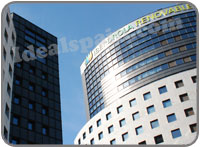
Pictured right are some of the modern hotels in Valencia. |
|
| |
| |
| |
| |
| |
|
|
| |
|
 |
|
Learn Spanish Today for FREE! Learn
Spanish the interactive and fun way! Our web site will help
you learn Spanish free of charge. Not just a few Spanish
verbs, but over 500 words of the Spanish language, including
complete Spanish phrases and sentences. Watch our free online
demo that plays the first 15 minutes of a lesson. In this
demo, the in program manual is displayed on the screen. |
| |
|
|
 |
|
Insure your home in Spain at unbeatable prices with simple, easy to understand policies in your language |
| |
|
|
|
|
|
|