The
Passion
of
Christ,
or
Easter
Week,
known
in
Spain
as
Semana
Santa
is
without doubt the
most
important
celebration
in
Spain.
The
festivities
begin with
the
Domingo
de
Ramos
(Palm
Sunday)
and
end
with
Lunes
de
Pascua
(Easter
Monday).
It
is
a
celebration
of
life
itself
and
the
whole
country
comes
alive.
The Catholic Church in Spain is passionate about Easter
celebrations.
Almost every town and city in Spain will have
their own Easter celebrations and almost every resident will
be involved in some way.
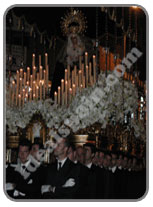
In the major cities the processions are of huge
proportions, often stretching for miles.
Each
area,
city
and
town
has
its
own
accent
on
its
celebrations.
They
all
differ
but
in
common
they
all
portray
life,
colour,
culture,
music
and
dance,
all
with
a
very
religious
meaning.
Everywhere,
processions
make
their
way
through
the
streets,
carrying
religious
icons
and
symbols
of
their
faith.
In
Seville
alone
there
are
over
100
of
these
such
images.
Semana
Santa
has
to
be
experienced
first
hand
to
be
fully
appreciated
and
no
words
can
begin
to
describe
the
emotions that
flow
like
water,
wherever
you
go.
If
you
have
the
opportunity
to
sample
these
festivities,
one
thing
is
sure,
the
images
of the solemn masses and processions will
stay
with
you
forever.
The
way
in
which
many
villages
and
towns
celebrate
Holy
Week
is
so
very
different
and
one
such
example
is
Almaden
de
la
Plata
near
Seville.
On
Easter
Sunday,
rag
and
straw
dolls
representing
famous
people
are
placed
at
different
points
in
the
streets
of
the
village.
These are
finally
torn
apart
and
the
pieces
thrown
into
the
air.
In
Castilblanco
de
los
Arroyos,
they
place
the
same
kind
of
dolls
in
the
streets
but
they
are
later
set
on
fire.
The
dolls
are
known
as juas or
Judas
dolls.
There
are
many
towns
that
celebrate
with
battles
between
ancient
brotherhoods.
In
major
cities
such
as
Malaga,
the
processions
go
on
for
miles
and
will
last
until
the
early
hours
of
the
morning,
every
night
through
the
Easter
week.
Children
as
young
as
3
or
4
take
part
and
crowds
will
swell
into
hundreds
of
thousands.
Some
of
the
images
are
quite
haunting.
You
will
find,
anywhere
in
Spain,
during
the
celebrations
that
accommodation
is
very
difficult
to
find,
especially
in
the
cities.
Many
people
resort
to
booking
a
year
in
advance.
You
may
also
find
that
the
price
of
accommodation
will
be
artificially
inflated
for
this
week.
Terminology of Easter in Spain
Corpus Cristi
This is the main ritual practiced in Spain at Easter. The streets are used as a grand stage for religious and passionate displays of devotion to Christ. People dress as members of ancient brotherhoods and parade through the town.
La Patum
This is a traditional Easter ritual that can include a procession of giants, monsters and devil like creatures.
Judas Dolls
Often made of straw and sometimes made to resemble famous people, these dolls are burned in the streets.
Semana Santa
Spanish for 'Holy Week'.
Costaleros
The name given to the people that carry the floats with the religious statues on. A 'Costal' is a small cushion often carried and used to stop the float causing sores when being carried long distances. These floats can weigh up to 6 tons.
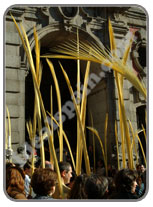
Domingo de Ramos
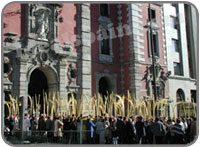
Palm Sunday. The first of the Easter Masses and processions. Palms are carried through the town. The palms are used to symbolise the palms that people threw on the road in front of Jesus as he entered Jerusalem. People carry small items made of woven palm which are often later burned. The ashes may be used in ceremonies on Ash Wednesday.
Procesion del Silencio
The Procession of Silence which is held on Jueves Santo (Holy Thursday).
Santo Entierro
The Holy Burial, honoured on Viernes Santo (Holy Friday).
El Domingo de Resurreccion
Easter Day on which everyone goes to church and celebrates the resurrection of Christ.
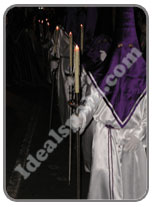
Nazarenos
These are people who follow the floats whose appearance could almost be confused with that of the Klu Klux Clan. The cone shaped head gear that is worn is actually due to the belief that it will bring them closer to the heavens.
Torrijas
A traditional Easter snack which consists of slices of bread soaked in a mixture of whisked eggs and milk then fried in olive oil and sprinkled with sugar. (Cooked similar to French toast).
La Mona de Pascua
A traditional Easter cake, with origins in the 15th century. These vary considerably and are often highly decorated.
Palm Sunday
Timetable for Easter in Spain
Domingo de Ramos (Palm Sunday)
Jueves Santo (Holy Thursday)
Santo Entierro (Good Friday)
El Domingo de Resurreccion (Easter Sunday)
Learn Spanish Today for FREE! Learn Spanish the interactive and fun way! Our web site will help you learn Spanish free of charge. Not just a few Spanish verbs, but over 500 words of the Spanish language, including complete Spanish phrases and sentences. Watch our free online demo that plays the first 15 minutes of a lesson. In this demo, the in program manual is displayed on the screen.
Bargain priced Insurance for your holiday home in Spain or for your Spanish home. Policies in English and English speaking helplines. The prices are the lowest you will find anywhere