|
|
Places in Spain -
The Camino de
Santiago
|
"El
Camino
de
Santiago"
(Saint
James
Way)
is
the
name
given
to
the
road
the
pilgrims
followed
in
the
middle
age
to
get
to
Santiago.
Many
institutions
(hospitals,
hotels)
were
founded
to
help
the
pilgrims
in
their
way
to
the
holy
city.
The
oldest
description
of
the
journey
is
from
the
12th
century:
the
'Codex
Calixtinus'
and
the
'Kitab
Ruyyar'
(by
the
Arab
author
Idrisi).
|
|
|
|
If you
want
to do
the
entire
"'Camino',
which
is
about
900 km
long
(from
France
to
Santiago)
it
will
take
about
30
days
(at 30
km a
day).
If you
just
want
to
receive
the
official
certificate
of
pilgrimage
(the 'Compostella')
you’ll
have
to
walk
at
least
100km
(200
km on
a
cycle).
A
network
of
shelters
along
the
way
offers
free
lodging
and
stamps
the
pilgrims
passports
which
provide
evidence
of
completion.
The
city
of
Santiago
de
Compostella
is
embraced
by
the
rivers
Tambre
and
Ulla,
in
Galicia.
The
city
was
founded
after
the
discovery
of
the
remains
of
the
Apostle
Santiago
in
the
9th
century.
Santiago
soon
became
a
pilgrimage
centre.
Probably
the
Apostle
legend
comes
from
the
transportation
of
the
remains
from
Merida
after
the
Muslim
invasion.
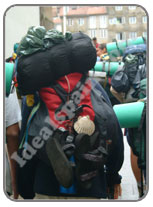
Many
of
the
modern
pilgrims
are
Catholics
who
think
the
difficult
journey
to
Santiago
will
halve
their
stay
in
the
purgatory,
at
least
this
is
one
of
the
historical
reasons
to
complete
the
Camino
de
Santiago.
But
you
don’t
have
to
believe
in
God
to
do
this
interesting
journey,
many
others
do
this
pilgrimage
purely
for
cultural
reasons
or
just
for
the
fun
of
doing
it.
|
|
 |
|
|
| |
| |
|
|
|
The
Camino
de
Santiago
had
three
major
European
routes
passing
across
France
from
North
to
South,
and
their
starting
points
were:
Paris,
Vezeley
and Lo
Pueg.
The
three
routes
met in
Ostabat
and
entered
the
Iberian
Peninsula
in
Roncesvalles
(in
Navarra).
When
the
pilgrims
reached
the
top of
the
Pyrenees
they
usually
dedicated
their
first
prayer
to
Santiago.
The
next
stop
was
usually
Pamplona
where
you
have
to
visit
the
Gothic
Cathedral.
From
there
the
route
passed
by
Puente
de la
Reina,
a
typical
pilgrimage
village,
with
many
Santiago
symbols
and
Estella,
a city
founded
in
1090
to
host
the
Santiago
pilgrims.
After
crossing
the
Ebro
river
the
pilgrims
enter
Logroño,
the
first
city
in
Castilla,
where
you
will
find
the
Santiago
Church.
Najera
(the
Navarra
court
residence),
Burgos
(a
major
pilgrimage
stop,
with
more
than
42
hospitals
in the
15th
century),
Sahagun-Leon,
Astorga,
Ponferrada,
Cebrero
(a
1296
meter
high
summit,
where
you
can
see a
fantastic
landscape
and
admire
the
traditional
Galician
houses
covered
with
straw),
Tricastela,
Sarria,
Portomartin
(crossing
the
Miño
river)
and
end in
Santiago
de
Compostella.
There
was a
secondary
route,
known
as the
Coast
Camino,
that
started
in
Bayona
(Basque
Country)
passed
through
Oviedo
and
ended
in
Santiago.
|
|
|
The
Camino
de
Santiago
was a
major
communication
link
between
the
different
peoples
in
Europe
for
several
centuries.
It was
the
place
where
the
cultural,
artistic
and
trade
exchanges
took
place
in the
middle
ages.
Currently
there
are
around
8
recommended
routes
to
walk.
Several
leave
from
France.
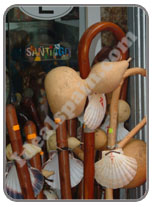
The
scallop
edged
conch
shell
is the
symbol
you’ll
find
along
the
'Camino
de
Santiago'
roads.
It was
used
to dip
water
from
streams
on the
way.
The
other
element
you’ll
find
everywhere
along
the
way is
the
stick,
thousands
of
pilgrims
complete
the
Camino"
every
year,
and
many
of
them
find
the
stick
very
useful. |
 |
|
|
The
modern
pilgrim
Most
of
those
who
walk
The
Way of
St
James
are
not
experienced
walkers
at
all.
Many
have
never
done
any
serious
walking
in
their
lives
and
many
will
never
do
serious
walking
again,
for
here,
it can
simply
be
undertaken
purely
for
the
sake
of
doing
it.
The
route
takes
in
many
small
villages
and
towns,
making
it
easy
to
find
places
to
rest.
Many
thousands
of
people
walk
the
way
every
year,
whether
from
the
Pyrenees,
from
different
parts
of
France
or
from
even
further
afield:
it is
not
uncommon,
even
nowadays,
to
meet
Swiss,
German
or
Dutch
pilgrims,
for
example,
who
have
set
out
from
home
to
make
the
entire
journey
on
foot.
Most
parts
of the
walker's
route
are
also
accessible
to
those
riding
mountain
bikes.
The
Cathedral
authorities
in
Santiago
maintain
a
register
of
pilgrims
and in
1991
recorded
a
total
of
7274
travelling
on
foot,
bicycle
or
horseback
(compared
with
5760
in
1989,
the
year
of the
Pope's
August
visit
there,
and
4918
in
1990).
The
walk
takes
about
a
month
and
there
are a
number
of
refuges
set up
to
accommodate
the
genuine
pilgrim
not
the
tourist.
Some
of
these
are in
old
monasteries,
inns
and
seminaries
others
are
provided
by the
villages
along
the
way.
Some
are in
grand
establishments
like
the
old
Augustine
Abbey
of
Roncesvalles
in the
Pyrenees
or the
12th
century
seminary
at
Puerto
Reina.
If you
do
complete
the
walk
all
the
way
and
can
provide
proof,
you
are
entitled
to
three
free
meals
for
three
days!
at the
magnificent
Hotel
de los
Reyes
at
Santiago,
apply
to the
cathedral
authorities. |
|
If you want to be completely facilitated for latest asvab exam prep then online CCNA Voice Introducing Cisco Voice dumps are perfect choice for you
If you are not well prepared for sat practice test exams then P4S online dumps are truly a perfect choice for you |
|
|
|
|