|
|
Places in Spain -
Santiago de
Compostela
|
Details on the
Camino de Santiago
here
Santiago
de
Compostela,
known
as the
'Town
of the
apostle'
is the
capital
of the
region
of
Galicia.
The
city
has
over
89,000
inhabitants
and is
located
at an
altitude
of
260m
above
sea
level.
The
city
is
just
76km
from
LaCoruña,
111km
from
Ourense
and
117km
from
Pontevedra.
Lugo
is
just
107km
away.
Santiago
de
Compostela
is
probably
best
known
as the
final
destination
of the
legendary
medieval
way of
pilgrimship
Camino
de
Santiago
(Way
of
Saint
James),
now
considered
by
Unesco,
a
World
Heritage
Site.
Today
the
city
attracts
visitors
from
all
over
the
world
thanks
to its
fantastic
monuments.
The
city
is
named
after
the
Apostle
Saint
James
("Santiago"),
who is
buried
here.
Santiago
is
certainly
one of
Spain's
most
monumental
cities,
with a
particular
architectural
style
all of
its
own.
The
city
also
has
one of
the
most
famous
universities
in
Europe
and a
large
number
of
students
give
the
city a
unique
ambience.
|
|
|
|
There
are
many
places
to
visit
within
the
city,
including;
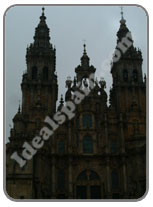
The
cathedral
Construction
of the
Cathedral
started
in
1075,
when
the
city
reached
its
peak
of
importance.
The
second
phase,
after
the
wedding
of
Doña
Urraca
and
Raimundo
of
Bourgogne,
shows
influences
of
French
Romanesque
style,
as
well
as a
style
that
is all
Santiago's
own,
the
so-called
Románico
Compostelano.
The
Obradoiro
Facade
(to
which
later
on
were
added
Barroque
elements)
and
the
towers
Torre
de las
Campanas
and
Torre
de la
Carraca
were
made
at
this
time.
Through
the
Obradoiro
Door
you
enter
the so
called
Old
Cathedral,
a
Romanesque
crypt
with
the
first
vaults
of
groined
arches
that
were
ever
built
in
Spain.
The
sculptures
of the
Portico
de la
Gloria,
another
entrance
door,
are
considered
some
of the
most
important
works
of
medieval
art.
|
|
 |
|
|
| |
| |
|
|
|
The
Hospital
Real
Built
in
1492
to
shelter
pilgrims.
Today
this
building,
in
Plateresque
and
Renaissance
styles,
serves
as a
Parador
de
Turismo.
The
Rajoy
Palace
A huge
and
elegant
neo-classical
building
of
18th
century,
located
opposite
to the
cathedral.
|
|
|
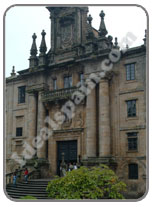
The
Colegio
de San
Jerónimo
and
Colegio
de
Fonseca
Both
15th
century
monasteries,
founded
by
Alfonso
III de
Fonseca.
In the
latter
there
is the
University
library,
and it
conserves
the
famous
11th
century
manuscript
Libro
de
Hojas.
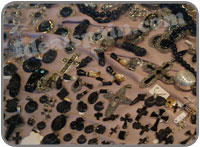
Pictured
left
is one
of the
best
crafts
in
Santiago;
jewellery
made
from
Jet.
The
small
shops
are
crammed
with
unique
pieces,
crafted
into
shells,
crosses
and
other
symbols.
Many
are
adorned
with
gold
or
silver. |
 |
|
 |
The
Gelmirez
Palace
Opposite
the
cathedral,
a
brilliant
example
of
Romanesque
civil
architecture.
Of
particular
interest
are
its
groined
arches
and
sculpture
works. |
|
|
|
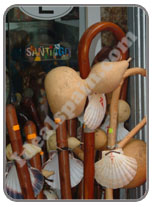
You
will
also
see a
profound
number
of
walking
sticks
in
Santiago
- the
symbol
of the
pilgrim,
along
with
the
shell,
symbol
of the
city.
Many
are
hand-made
in the
area
and
are
very
cheap.
|
 |
|
Plaza
de las
Platerias
This
square
is
named
after
the
many
shops
of
silver
articles
(Platerias)
which
are to
be
found
under
its
arcades.
From
here
you
can
see
the
cathedral's
gothic
portal
and
the
only
facade
which
is
conserved
in the
original
Romanesque
style,
with
fantastic
sculpture
works,
such
as the
figure
of
King
David.
Worth
seeing
is the
Fuente
de los
Caballos,
a 19th
century
fountain
in the
centre
of the
square,
the
Casa
del
Cabildo,
of
18th
century,
and
Casa
de los
Canónigos
(also
called
Conga),
another
18th
century
palace
that
separates
Plaza
de las
Platerias
from
Plaza
de la
Quintana.
Plaza
de la
Quintana
From
this
square
you
see
the
Portico
Real,
(Royal
Door),
of the
cathedral,
the
towers
Berenguela
and
Torre
del
Reloj,
as
well
as the
Puerta
del
Perdon.
This
door
is
opened
only
in a
Holy
Year,
during
the
Apostle
Festival.
The
Monastery
of San
Pelayo
de
Antealtares
With
its
austere
facade
of
granite
this
is one
of the
oldest
buildings
in
Santiago.
It was
founded
in the
11th
century
by
Alphonse
II in
order
to
entomb
the
mortal
remains
of the
Apostle
James
there.
The
Baroque
Casa
de la
Parra
is
another
attraction
at
this
square.
Plaza
de la
Azabacheria
To
this
square
opened
originally
the
legendary
Puerta
del
Paradiso
(door
of
paradise),
through
which
the
pilgrims
entered
the
cathedral.
It was
replaced
by a
neo-classical
work
of
Ventura
Rodriguez,
which
is to
be
seen
today.
The
Monastery
of San
Martin
Pinario
Of
16th
century
construction,
this
is one
of the
most
impressive
examples
of
Barroco
Compostelana.
It was
built
over a
Romanesque
church,
which
has
always
been
an
important
medieval
religious
centre.
The
Convento
de San
Francisco
Legend
tells
us
that
this
convent
was
founded
by
Saint
Franciscus
of
Assisi,
after
a
revelation
on his
pilgrimship
to
Santiago,
during
1213
to
1215.
God
told
him he
should
buy
land
from
the
monks
of
Saint
Martin's
Monastery
for
the
symbolic
price
of a
basket
of
fish,
and
then
build
a
monastery.
Little
is
left
of the
original
Gothic
building.
The
monastery
as we
see it
today
was
built
in
17th
and
18th
centuries.
In
Rua
Nueva,
(New
Street),
is the
12th
century
Romanesque
church
Santa
María
Salomé.
Its
Baroque
tower
was
added
later
on.
Close
by are
some
interesting
palaces:
Palacio
de
Ramirans,
Palacio
de los
Condes
de
Gimonde,
Casa
de las
Pomas,
and
Palacio
de
Mondragón. |
|
|
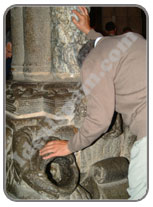
Pictured
right
is
inside
the
cathedral.
A
ritual
that
has
continues
for
hundreds
of
years;
The
Portico
de
Gloria
dates
from
the
12th
century
and is
one of
the
most
important
works
of art
in
Spain.
The
ritual
involves
placing
your
hands
on the
mullion
then
tapping
your
forehead
three
times
against
the
figure
of
Master
Mateo. |
 |
Fiestas
As
with
the
rest
of
Spain,
Semana
Santa,
(Easter
week)
is
celebrated
with
impressive
processions
and is
the
most
important
celebration
in
Spain.
In May
takes
place
the
interesting
Feria
del
Ganado,
which
lasts
for 10
days.
As
well
as
performances
by
folk
groups
it is
also a
culinary
festival
and
you
have a
great
opportunity
to try
all
the
specialities
of the
regional
kitchen.
If
you
are in
Santiago
at the
end of
July,
don't
miss
the
Festival
of the
Apostle.
On
July,
24th
is the
Fuego
del
Apostol,
great
fireworks
display
in
front
of the
Obradoiro
door
of the
cathedral.
The
next
day,
during
mass,
a huge
incense
font
that
is
fixed
to the
ceiling
of the
cathedral
with a
rope
is
swung
through
the
nave.
In
August
and
September
takes
place
an
important
Festival
of
Classical
Music
with
numerous
concerts.
|
Contact
Nº's
for
Santiago
de
Compostela |
|
Fire
service
|
080
Emergencies
|
|
Guardia
Civil
|
062
Emergencies
|
|
Forest
Fires
|
085
Emergencies
|
|
Local
Police
|
092
Emergencies
|
|
National
Police
|
091
Emergencies |
|
Medical
Urgencies
|
061
Emergencies
|
|
Taxis |
981
585
973 |
|
Local
Tourist
Office |
981
555
129 |
|
Lost
Property
Office |
981
543
027 |
|
Consumer
Office |
981
542
314 |
| |
|
Parks
and
gardens
Parque
de
Belvís:
Parque
de San
Domingos
de
Bonaval:With
convent
and
museum
Parque
do
Monte
da
Almaciga:
Parque
de
Xixón:
Parque
de
Carlomagno:
Near
National
Police
Station
Alameda:
Central
park
with
church
in
centre
Xardíns
de
Mosquera
Pérel:
Near
sports
stadium
Parque
da
Música
en
Compostela:
Housing
the
Auditorium
Parque
de
Pablo
Iglesias:
South
side
of
city
near
Praza
de
España
Parque
Eugenio
Granell:
Close
to
RENFE
station |
|
|
| |
|
|
|
|