Palma, in Mallorca is the capital of the Balearic Islands and is the economic and cultural hub of the island. Located on the south coast of Mallorca, it also forms an important holiday resort and commercial port. Palma offers the island's best choice of hotels, restaurants and widest choice of entertainment.
Despite having become a modern, vibrant city, Palma has managed to retain its old town and its ancient culture and charm.
Palma's airport handles millions of visitors each year and plays a major role in the Balearic's tourism industry.
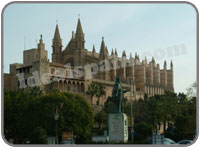
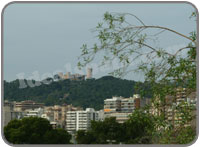
Some of Palma's best attractions are to be found near the port, including the Royal Palace, the Stock Exchange and the Castle of Bellver that has dominated the skyline since the 14th century, however, Palma's pride and joy has to be the Cathedral, one of the world's finest and largest Gothic structures. The old town of Palma fans out from the cathedral and is a maze of narrow streets, flanked by ancient mansions and hidden squares.
Almost half the entire population of the Balearic Islands live in Palma, some 325,000 of them, although this number can swell to 600,000 in the summer. Palma was recently voted the best place in Spain to live !
Advertise With
Us
Put
your company
in front of
nearly half a
million
people, every
month
What to see in Palma
The Cathedral In Gothic style it was begun in the 13th century by Jaime I. It has high arches and elegant columns. There are many interesting tombs including those of Jaime I and Jaime III of Mallorca. You will also find a museum inside the cathedral. The cathedral is closed on Sundays and holidays. In front of the cathedral is the Parc de la Mar with its impressive fountains and sculptures. Next to the cathedral is the Palau de l'Almudaina which was the Royal residence in the Middle Ages. It now houses an interesting museum.
The Castell de Bellver
With a small admission charge, this castle is a must-see. Built in 1309, it is the only castle in Spain that is totally circular in design. The castle began as a summer Royal residence and was later used as a prison. Look out for the graffiti on the walls, carved by French prisoners of war. The castle also houses the principal museum and is often used for concerts. The castle is closed on Sundays and public holidays.
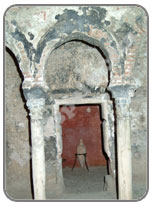
TheArab Baths Theseare open 9.30am - 8pm and are very cheap to visit. They are hidden away in the tiny streets, east of the cathedral. The baths date from the 10th century and are surrounded by well tended gardens. The interior of the baths is pretty much as it was built.
The Town Hall This buildingis of 17th century construction and is charming and full of character. It is surrounded by stone benches on which the locals love to sit.
The only way to see the old town of Palma is by foot and you can be sure that around every corner is a quiet plaza or park to rest in. Wherever you stay on the island, Palma is accessible as a day visit on one of the thousands of coaches that arrive here every day.
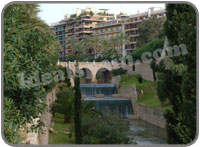
Palma is also a cultural centre with every kind of entertainment possible, from cinemas to theatres, operas and rock concerts. There is every manner of restaurant available and thousands of bars. We discovered a wonderful little restaurant close to the old town and cathedral. Brusellas Restaurant is based under the city in an old watercourse and stables. The meals are first class and the staff are wonderful. If you want to be guaranteed of a perfect evening, check it out.
Palma is also the location for the islands airport and the largest port in Mallorca. The port still has a working fishing fleet as well as a leisure marina for vessels of all sizes. There is also a sailing club.
Tourist offices in Palma
Placa de Espana - Tel 902 102 365
Puerto de Palma, Estacion Maritima - Tel 608 173 307
Plaja de Palma, Plaza de Meravelles - Tel 902 102 365
Placa de la Reina, 2 - Tel 971 173 990
Airport - Tel 971 789 267
Passeig del Born, 27 - Tel 902 102 365
Tourist bus
Palma has a tourist bus which makes stops at all the most important points in the city, as well as providing an audio guide in different languages. You can get on and off as many times as you like. The basic fare is €13, and €16.25 for two days.
Taxi tours
The Taxi Tour offers a tour of the most interesting sights, and costs €30 for one hour, €60 for two hours and €90 for three hours.
Tourist train
There is also a tourist train which departs from the Playa de Palma beach and runs along the beachfront. The return fare, valid for within the day, is €3.25 (there is no service in winter).
Underground in Palma
The price of the underground ticket is 90 euro cents, although there are 20-ride tickets costing €12 and 40-ride tickets for €19.20. The underground runs from 6.30am-10.30pm.
Low cost car hire in Mallorca - Instant quotes, online booking and guaranteed reservations. Access to all the top car hire companies in Spain