|
|
Places in Spain -
Salamanca
|
The
Province
The
province
of
Salamanca,
within
Castilla
y Leon,
has
much
in
common
with
its
neighbour
Extremadura.
The
countryside
is
fairly
typical
where
fighting
bulls
graze
alongside
flocks
of
sheep
and
vast
areas
are
planted
with
wheat.
The
area
has
more
than
its
fair
share
of
rivers,
the
largest
of
which
is the
Rio
Tormes.
The
mountains
of the
Sierra
de
Bejar
are
snow-capped
in the
winter
and
the
weather
can be
miserable,
however
the
summer
days
can be
long
and
hot.
Much
of the
area
is
hardly
populated
and
the
countryside
is
dotted
with
little
villages,
locked
in
time.
Salamanca
has
been
occupied
since
prehistoric
times,
proved
by
cave
paintings
in the
south.
Read
more
about
the
history
of
Salamanca
here.
|
|
|
|
|
| |
Salamanca
City
An
ancient
city
famous
for
its
university
founded
in the
1200's.
Located
north
west
of
Madrid
and
just
117km
from
Portugal.
Voted
one of
the
World
Heritage
Cities
by
UNESCO,
one of
6 in
Spain.
The
university
has
much
influence
on
Salamanca
and
brings
it a
great
deal
of
life.
The
only
way to
see
the
city
is by
foot
and a
good
place
to
start
is the
Plaza
Mayor,
in the
centre,
voted
the
best
public
Plaza
in
Spain.
Note
the
splendid
City
Hall
with
its
clock
tower.
You
will
also
find a
helpful
tourist
office
in
this
square.
From
here
you
will
be
able
to
walk
through
the
arcade
of
shops,
picking
up the
latest
fashions
and
hand-made
goods.
You
will
be in
easy
reach
of the
Old
Cathedral
where
you
can
see
the
Gothic
tombs
of
past
Bishops.
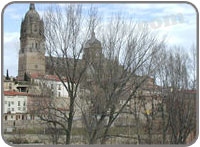
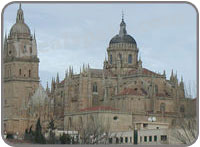
The
New
Cathedral
is
located
in
Plaza
Juan
XXII
and
dates
from
1513.
|
|
 |
| |
|
|
| Low cost car hire in Salamanca - Instant quotes, online booking and guaranteed reservations. Access to all the top car hire companies in Spain |
|
The
New
Cathedral
was
constructed
to
accommodate
the
huge
number
of
students
attending
the
university
and it
took
200
years
to
build.
The
city
also
has a
wealth
of
important
churches,
some
of
which
date
back
to the
11 and
1200's.
In the
Plaza
de San
Esteban
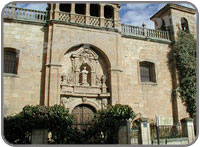
stands
the
Monastery
of San
Esteban.
Construction
started
in
1525
by
order
of the
Bishop
of
Cordoba.
It was
completed
by
1618.
The
front
of the
church
shows
some
fine
sculptures
and
the
interior
houses
several
impressive
murals.
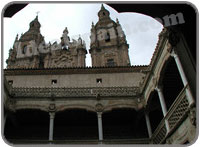
Within
the
structure
there
is a
lovely
green
courtyard.
Salamanca
has
five
Convents,
all
are
worthy
of a
visit. |
 |
| |
|
| Within
the
city
you
will
see
numerous
palaces
and
important
houses.
Look
out
for
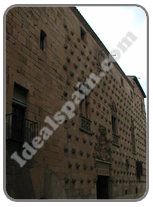
the Casa
de las
Conchas,
House
of
Shells
(right).
This
unusual
building
was
built
at the
start
of the
16th
century.
Details
of its
history
are
unclear
but it
would
seem
that
the
builder
was a
Knight
of
Santiago
so he
applied
the
most
common
symbol
of the
order,
the
shell.
The
coat
of
arms
also
features
on the
corner.
The
front
features
the
coat
of
arms of the
Catholic
Monarch.
One of
the
most
important
buildings
in
Salamanca
is the university.
It was
founded
in
1218
by
Alfonso
IX of
Leon.
The
university
occupies
most
of the
city's
important
buildings.
One
such
example
is the Hospital
del
Estudio which
is now
the
University
Rectory.
It was
founded
before
1469
and
rebuilt
around
1472. |
|
|
|
|
|
The
streets
of
Salamanca
are
both
an
education
and a
pleasure
and
you
will
often
stumble
across
a
plaza
or a
courtyard
in
which
to sit
and
watch
life
go by.
The
presence
of
students
within
the
city
gives
it a
constant
vibrant
feeling,
especially
at
night.
You
will
find
every
kind
of
restaurant
within
the
city
as
well
as
bars,
theatres,
museums
and
cinemas.
Salamanca
is a
wonderful
city
to
visit,
no
matter
how
long
your
stay.
|
 |
|
Our
visit
to
Salamanca
was in
January
2002.
We
found
the
city
very
interesting
and
the
streets
had a
vibrant
life.
The
architecture
was
interesting
and
varied.
The
shopping
area
was a
good
visit
and
the
restaurants
were
very
welcoming.
The
city
was
easy
to get
in and
out
of,
the
traffic
not
too
bad.
Parking
was a
problem
as it
is
with
any
city.
The
presence
of the
university
is
felt
on
every
street
corner.
|
 |
 |
| |
|
|
| |
|
|
|
|