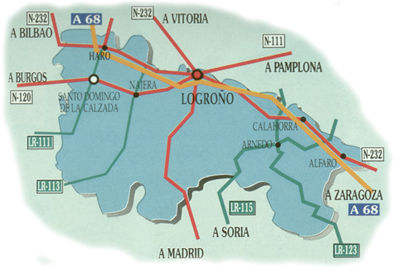
|
La
Rioja
is the
smallest
region
of
mainland
Spain,
bordered
by
Navarre,
Castile
& Leon
and
Aragon.
One of
the
most
important
wine
growing
areas
of
Europe,
it has
a
reputation
bigger
than
its
land
area.
Extending
along
the
Ebro
River,
the
region
is
practically
split
into
two,
Rioja
Alta
which
has a
great
deal
of
rainfall
and
has a
mild
climate,
and
Rioja
Baja
which
is a
hotter
and
more
arid
area,
similar
to
Aragon.
The
province'
capital,
Logrono
links
the
two
areas.
The
most
popular
places
to
visit
are
Logrono
and
Haro,
known
for
their
wineries. |
|
The
region
is
rich
in
natural
attractions
and
offers
the
visitor
a
great
deal
as
well
as the
many
opportunities
to
taste
the
famous
local
wines.
This
region
offers
great
possibilities
for
rural
tourism,
and if
you
like
hunting,
fishing,
climbing
or
hiking
this
is
where
you
need
to be.
|
|
 |
From
the
air,
La
Rioja
looks
like a
large
bowl,
a
depression
surrounded
by
mountains.
The
mountains
protect
the
area
from
the
elements
which
gives
the
area
its
own
climate
that
is
particularly
good
for
the
growing
of
grapes.
Despite
the
fact
that
La
Rioja
produces
fantastic
wines,
some
of the
best
wines
in
Spain
come
from
the
Basque
Country.
The
Rioja
wines
have a
character
of
their
own
and in
some
areas
the
wine
is
still
fermented
in
whole
bunch
and
foot
treading
style.
A
particular
good
wine
made
under
these
conditions
is the
Vina
Lur.
It is
best
to
avoid
the
cheap
wines.
A year
spent
in oak
barrels
is
worthy
of the
extra
cost. |
|
|
|
La
Rioja
has a
varied
history
dating
back
to
prehistoric
times
when
it was
inhabited
by
Celtiberian
communities.
The
Romans
occupied
the
area
in the
second
century
BC and
maintained
control
for
seven
centuries.
Later,
Germanic
tribes
came
down
from
the
north
but
were
expelled
in the
8th
century
by the
Moors.
During
medieval
times,
thousands
of
pilgrims
were
moving
around
Europe
and
the
Islamic
and
Christian
kingdoms
were
at
odds.
La
Rioja
was a
territory
disputed
over
by
Castile,
Navarre
and
Aragon.
The
Catholic
Monarchs
united
the
Spanish
territory
at the
end of
the
15th
century.
In
1833
La
Rioja
became
an
Autonomous
Community.
|
 |
Cuisine
The
delights
of La
Rioja
cuisine
are as
wide and
varied as
its
landscapes.
From heavy
stews in
the north
to lighter
dishes in
the south.
Potatoes
flavoured
with a
spicy
sausage
called
chorizo
is one of
the most
typical
dishes.
Young goat
or lamb
roasted
over vine
prunings
is another
favourite.
Trout,
Barbel,
tripe
dishes and
cheeses
are
present in
most
menus.
Fresh
vegetables
are also
in
plentiful
supply.
Crafts
The
region has
a wide
range of
crafts to
offer such
as the
famous,
fine
furniture,
barrels,
utensils
and wooden
carvings,
leather
goods,
tapestries
and wicker
work.
Colourful
ceramics
and metal
work also
abound in
the area.
Leisure
The
mountains
of La
Rioja are
a paradise
for
hiking,
climbing
and other
mountain
related
sports.
Skiing
facilities
can be
found in
Valdezcaray,
aerial
sports can
be
practiced
in Lardero
and water
sports in
El Rasillo.
Cycling is
popular
throughout
the whole
region.
Hunting is
possible
in three
areas and
you can
fish for
trout,
barbel and
crabs. For
more
information
about
permits,
call +34
941 29 11
00.
Fiestas
There are
four
fiestas of
interest
to the
tourist:
La
Vendimia
is held in
Logrono
on
September
21st and
is a
display of
grape-treading,
floats and
wine-tasting.
The
fiestas in
Santo
Domingo de
la Calzada
on
May 12th
include
parades
and dances
which
extend
into the
neighbouring
villages.
La
Batalla
del Vino
in
Haro
on June
29th is an
authentic
battle
with the
'blood of
the earth'
used as
the only
weapon,
dousing
the
participants
in a
shower of
wine. The
ancient
Danza de
los Zancos,
held in
Anguiano
on June
22nd is a
day of
traditional
dancing on
stilts.
|