|
The Village of
Mijas, aptly
named 'Villa
Blanca', or
'white town'
can be found
perched high
on the
hillside
alongside the
N340 highway
near
Fuengirola on
the
Costa del Sol,
Andalucia.
If there were
ever a typical
Spanish
village worthy
of a visit
then this is
the one. |
|
|
|
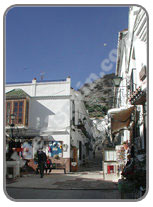
Make your way
up the
winding,
narrow road
towards the
village and
see the
white-washed
houses
arranged in
tiers,
clinging to
the hillside.
The road
narrows as you
enter the
village that,
despite its
popularity
with the
tourists, has
managed to
retain its
Spanish
individualism
and character.
The town
council have
used the
village's
charm to its
full and
exploited its
attractive
character by
providing for
the thousands
of tourists
who flock here
in the summer.
|
|
 |
|
|
|
All over the
village are view-points and resting places, one of the best
being the Muralla
Gardens,
cleverly
designed so
that flowers
are in bloom
all year
round. The
Plaza de la
Virgen de la
Pena is
another such
place to sit,
with the
bandstand in
the centre.
|
| |

Video of Mijas Pueblo
|
|
|
|
|

Video of the
Water Park in Mijas |
|
|
|
|
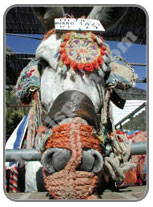
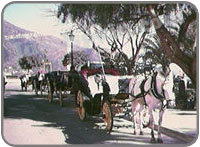
Within Mijas
there are so
many beautiful
streets that
have to be
seen, it would
be unfair to
mention any
one of them .
Tiny shops
line most of
them, all
brimming with
the local
wares such as
ceramics and
leatherwork,
jewellery and
paintings. One
of the best
ways to see
the village is
by means of
the local taxi
service, being
a quaint,
typical
Spanish donkey
service. For
6€ you can
take a donkey
ride around
the streets,
or indulge in
luxury and
spend 12€ for
a small cart
pulled by a
donkey. Horse
and carriages
work the
summer months
and can be
found in Plaza
de Pina.
|
 |
|
|
 |
The village is
split into
several
levels, each
being
connected by
narrow roads
and wonderful
walkways.
Plaza de la
Paz (Peace
Square) keeps
up to its name
as you sit in
one of the
street bars
and soak up
the
atmosphere.
This plaza is
marked by a
white statue
of a hand and
a dove. La
Plaza de la
Constitucion
is in the
heart of the
village and in
the centre of
the square is
a beautiful
fountain from
which the
birds drink.
This fountain
was carved by
Galiano. The
square is
surrounded by
cafes and
shops. Here
you will also
find the
Farmacia.
|
|
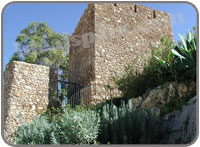
You are
confronted
with so many
opportunities
to see the
history of
this sweet,
little
village, such
as the
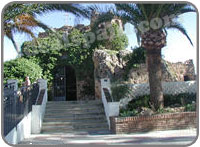
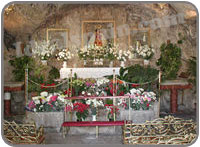
Santuario
de la Virgen
de la Pena,
carved out of
solid rock and
a tribute to
the patron
saint of
Mijas. The
shrine dates
back to 1586
when an image
of the Virgin
miraculously
appeared
there.
Subsequently
an image of
the Virgin was
found
concealed in a
recess in the
tower where it
had been
hidden for 500
years. |
 |
|
|
 |
Perched high
on the
hillside,
above the
village is the
Shrine of the
Calvario,
built in 1710.
It can be seen
for miles,
peacefully
watching over
the village.
From here
wonderful
panoramic
views can be
had. Access is
gained by
means of a
winding path
from the
village. The
interior of
the shrine is
only open on
Easter Friday
but the views
are worth the
long walk at
any time of
year.
Other
attractions
include the
village
bullring
which
strangely
enough is of
oval
construction,
opened in 1900
and still
providing
entertainment
in the form of
bullfights and
horse displays
to this day.
The Mijas
Museum in the
old town hall
has a wealth
of exhibits
and a gallery
of work by
local artists.
The
bullfighting
museum is
located at the
bullring and
is dedicated
to the history
of
bullfighting.
In the Santana
district
stands a small
18th century
hermitage
known as the
Iglesia de
Santa Ana.
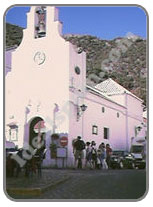
The Church of
San
Sebastian
is also worth
noting, with
its wonderful
facade. It
dates from the
17th century
and was
rebuilt in
1674 thanks to
charity
contributions.
Altogether
Mijas is a
Spanish
experience
never to be
forgotten and
day or night,
a visit here
will leave
images with
you for ever. |
|
|
Because of its
hilltop location Mijas has splendid views all round. The best can
be had from the church on the hill or from the park at the top of
the village. If you arrive by coach, the coach park is in the
middle of the village and you will need to climb the steps to the
main town and main square. The square is surrounded by tourist
shops and several very good restaurants. Mijas also offers a
couple of museums. The
folk museum
shows the
history of
Mijas and
trades of
bygone years.
There is a
unique
miniature
museum,
established in
1972 by a
famous
hypnotist and
located in a
caravan. It
displays items
from 50
countries. |
 |
|
Local fiestas
17th January -
Typical fair
celebrated in
the area of
Osunillas,
including a
pilgrimage to
the San Anton
Shrine.
March-April -
Semana Santa
(Easter Week)
the biggest
celebration in
Andalucia.
8th September
(aprox.) -
Annual week
long fair
paying homage
to Patron
Saint of
Mijas, the
Virgen de la
Peña.
Other local
attractions
Horse
racing at the
Hippodrome,
along the
coast. Tel +34
952 592 700
Water park
on Mijas Costa
- Tel +34 952
460 404
Sports centre
in Mijas - a
range of
sports all
year round.
Tel +34 952
478 241
 |
|
| Local Police Emergencies |
092 |
|
| National Police Emergencies |
091 |
|
| Fire Brigade |
952 461 046 |
|
| General Emergencies |
112 |
|
| Ambulance |
061 |
|
| Mijas Carlos Haya Hospital |
952 390 400 |
|
| Town hall |
952 835 391 |
|
| Casa Museum |
952 590 380 |
|
| Molino de Harina |
952 586 926 |
|
| Miniature Museum |
952 589 034 |
|
| Culture & Sports Centre |
952 587 750 |
|
| Sports Centre |
952 478 241 |
|
| Gymnasium, Mijas Pueblo |
952 486 094 |
|
| Football Ground, Mijas |
952 587 750 |
|
| Mijas Golf |
952 476 843 |
|
| Tourist Office, Mijas Pueblo |
952 589 034 |
|
| Plaza de Toros (Bullring) |
952 485 248 |
|
| |
|
|
|
|
Our travels to
Mijas Pueblo
We have
visited the
village on
several
occasions now
and each time
we are
astounded by
its beauty and
its charm. We
have rested in
most of the
squares and
watched the
tourists
mingle with
the locals,
all of whom
are friendly.
Mijas is a
typical
example of the
best that
Andalucia has
to offer and
is worth the
trek from the
throb of the
coast and its
concrete
jungles.
Access is
however a
trial, the
winding
streets
difficult to
navigate when
busy and
parking is a
stroke of
luck. We found
the best place
to head for is
the area near
the coach
park, past the
town hall. The
atmosphere in
Mijas is quiet
and tranquil
and its a
place that
demands more
visits. You
will see true
Andalucian
architecture
and find it
easy to
picture Spain
50 years ago.
Make sure you
have a good
pair of
walking shoes
or an ample
supply of corn
plasters. |
|
|
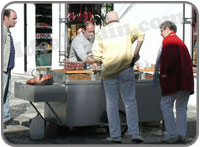
Sampling the
local
specialities,
you will come
across 'garrapinadas',
which are
caramelised
almonds,
cooked in the
street, fresh
olives and 'churros'
which are
fritters.
Pictured right
is one of many
street vendors
selling
almonds. |
 |
|
|
| |
|
|