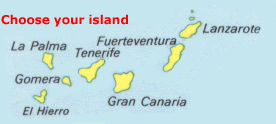
La
Palma
is
the
northernmost
island
and
is
referred
to
as
'la
Isla
Bonita'
because
of
its
immense
natural
beauty.
The
capital
is
Santa
Cruz.
Since
ancient
times
the
climate
has
been
the
most
outstanding
attribute
of
the
islands.
It
has
been
described
as
perpetual
springtime.
The
Greeks
called
the
islands
the
'Fortunate
Islands'.
The
fame
of
the
Canaries
as
a
travel
destination
began
in
the
18th
century
when
Europeans
began
to
visit
the
volcanic
landscapes.
The
fame
of
the
islands
grew
as
a
place
of
rest.
The
islands
are
currently
one
of
the
top
destinations
for
European
tourism,
welcoming
more
than
8
million
visitors
a
year.
50%
of
visitors
to
the
islands
return
at
some
point.
The
islands
present
more
than
1,100km
(930
miles)
of
coastline,
most
of
which
comprises
of
magnificent
beaches.
Coupled
with
the
allure
of
volcanoes,
forests
and
other
spectacular
scenery,
the
islands
have
much
to
offer.
The
waters
of
the
Atlantic
are
slightly
cooler
in
the
Canary
Islands
due
to
the
fact
that
the
Gulf
Current
moves
in
a
north
to
south
direction.
The
ocean
between
the
islands
is
a
deep
blue
colour
due
to
the
depth
of
up
to
3,000
metres.
Much
of
the
sand
on
the
beaches
is
pure
white.
Some
of
the
beaches
in
Tenerife
are
covered
with
golden
sand,
imported
from
the
Sahara
desert.
The
temperatures
here
are
mild,
rarely
going
below
19ºC
in
winter
or
above
25ºC
in
the
summer.
Hotels
on
the
islands
can
accommodate
more
than
400,000
visitors
and
are
among
the
best
in
Europe.
Most
of
the
hotels
are
located
along
the
coastal
strip,
however,
there
is
an
increasing
number
of
hotels
springing
up
in
rural
areas,
offering
a
very
different
type
of
holiday,
including
hiking,
biking
and
other
outdoor
pursuits.
The
islands
offer
13
golf
courses,
141
nature
reserves,
4
national
parks,
29
archaeological
monuments
and
hundreds
of
volcanoes.
The
culture
Because
of
the
location
of
the
islands,
the
people
have
developed
a
personality
combining
many
different
cultures.
Much
of
the
old
traditions
have
been
preserved
and
folk
music
and
folk
lore
are
part
of
daily
life.
Canarian
handicrafts
have
also
survived.
The
islanders
offer
unique
linen
and
lace
as
well
as
pottery.
The
most
important
festival
is
without
doubt
the
carnival
in
February
although
there
is
not
one
month
goes
by
without
some
kind
of
fiesta.
The
cuisine
Another
great
attraction
of
the
islands
is
the
food.
Its
simplicity
emphasises
the
quality
of
the
vegetables,
fresh
fish
and
excellent
meats.
Thick
soups
are
popular
along
with
marinated
meats. |