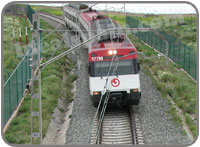
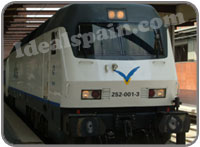
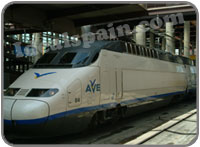
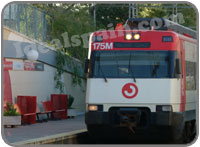
| Because of the mountainous regions of the country, Spain has never really been the best place to have railways and many areas are still inaccessible. However, rail is a wonderful and exciting way to see Spain, especially if travelling with children. Most of the 15,000km of rail in Spain is run by RENFE which runs fast, modern trains on its intercity routes. Far more interesting though are the narrow gauge (1 metre) lines that still serve parts of the country. These are more noticeable in the north where there are the FEVE trains that run through Galicia, Asturias and Castilla y Leon. |
| One of the most scenic runs is the narrow gauge that runs from Alicante to Denia on the Costa Blanca. The FGV rail was built by a French company in 1914 to transport fresh produce to Alicante. The 93km route passes colourful fishermen's houses, deep gorges, the massive rock at Calpe and the white-washed village of Altea. |
|
|
|
| Between Benidorm and Gata de Gorgos runs a restored 1930's fleet of coaches by the name of the Limon Express. The line is of the most scenic and runs alongside golden beaches. One of the quaint stations even doubles as a beach bar in the summer. When the train arrives at Gata, passengers are given a tour of a guitar factory and are shown typical wicker work of the area. On the return journey passengers are served with wine whilst admiring the fantastic views of the coastline. Details of The Limon Express can be had on 966 803 103 Fax 966 808 521. |
| Spain is also proud of the number of steam trains that have been restored and brought back into use. The best known is the Tren de la Fresa (Strawberry Train) that runs from Madrid to the palace at Aranjuez. its name is due to the fact that the line used to take fresh strawberries to the capital. The tradition is carried on to this day, with fresh strawberries being handed out to passengers en route. |

|
|
If
you
want
to
experience
the
ultimate
train
travel
then
take
one
of
the
country's
luxurious
specials.
The
Transcantabrico
follows
the
north
coast
of
Spain
from
San
Sebastian
to
Santiago
de
Compostela.
its
four
coaches
include
a
pub
with
resident
D.J.
The
trip
takes
8
days.
At
night
the
train
parks
in
stations
to
allow
passengers
to
get
a
good
night's
sleep.
In
the
south
the
Al
Andalus
Express
is
a
mobile
hotel
that
consists
of
12
coaches.
its
route
takes
in
all
the
Moorish
sites
of
Andalucia.
On
board
are
two
luxury
restaurants,
a
bar,
a
lounge
and
games
car.
Each
of
the
coaches
has
a
documented
history
of
their
being
built
in
the
1920's.
For
the
train
enthusiast,
Spain
has
its
fair
share
of
rail
museums.
The
best
by
far
being
the
one
in
Madrid.
The
Museo
del
Ferrocarril
was
opened
in
1967
and
was
was
the
first
museum
of
its
kind
in
Spain.
The
museum
uses
four
lengths
of
track
to
display
31
trains.
As
well
as
the
main
museum
there
is
a
small
side
museum
showing
uniforms
and
memorabilia. |
|
|
|
|
|
|
We have
travelled on
the train from
Malaga to
Madrid and
report the
following;
The train we
travelled on
was not the
high speed but
was faster
than the
regional
service. The
cost was
84.80€ each,
return. The
service was on
numbered seats
so obviously
limited
places. The
train was also
very busy. The
train only
made three or
four stops,
including
Cordoba.
The train
included two
bar carriages
at which you
could obtain
drinks and
sandwiches.
There were
toilets at the
end of each
carriage and a
smoking area
between
carriages. The
coaches were
comfortable
and
air-conditioned.
A very smooth
and enjoyable
journey (if
not a little
long at 4 and
a half hours).
The station at
Madrid was
very well
organised and
easy to use. |
|
|
|
Bargain Priced
Hotel Bookings
in Spain
- In
cooperation
with Bookings
on-line hotel
reservations,
idealspain.com
offers you
direct and
easy access to
a range of
hotels,
complete with
up-to-date
availability
information.
On the
BOOKINGS pages
you will find
brochures of
the hotels,
room rates,
hotel
packages,
special offers
and last
minutes,
including
real-time
booking
facilities for
all hotels. |
|
|
|