|
Malaga,
located in
Andalucia
is the capital city of the
Costa del
Sol
and is steeped in over 3,000 years' history. It has been inhabited by
the Romans, the Moors and the Carthaginians all of which have left their
mark on this wonderful city.
Malaga
serves as
both a
major port
and an
industrial
centre for
the south
of Spain.
Having a
large
international
airport,
it is also
an
important
gateway to
the rest
of the
world,
Malaga
airport is
one of the
largest Airports in
Spain and
during
2001
handled a
record 10
million
passengers. See a full feature here |
|
|
|
|
Malaga is
easy to
get to by
means of
the N340 (AP7)
highway
and the
coastal
railway that runs from Fuengirola.
Trains
will drop
you at the
Malaga
Central
which is
located
next to
the main
post
office and
just a
short walk
from the
main
tourist
attractions.
As you
leave the
station,
turn right
and you
will find
the first
tourist
office who
will issue
you with a
free plan
of the
city.
Carry on
over the
bridge
down
Alameda
Principal
to find
the
Cathedral. There's also a major rail station with trains from all over Spain.
|
|
 |
|
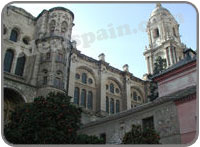
The Cathedral |
|
 |
| |
| |
| |
| Low cost car hire in the Malaga area - Instant quotes, online booking and guaranteed reservations. Access to all the top car hire companies in Spain |
|
|
|
Malaga Cathedral
It is
known
as La
Manquita
which
means
'the
little
one
armed
lady.'
The
Cathedral
incorporates
renaissance,
Baroque
and
neo-classical
styles
due to
the
length
of
time
it
took
to
construct. Full feature and photos here
The
Cathedral
has
only
one
tower.
There
was to
be a
second
but
this
was
never
completed
due to
lack
of
money.
Inside,
one
can
find a
Gothic
altar and a
statue
of the
Virgin
Mary.
There
are
fine
carvings
of
saints
in the
choir
area.
Explore
the
Cathedral
from
every
angle
as
every
facade
is
very different. There is a small charge to look around. |
|
| |
|
|
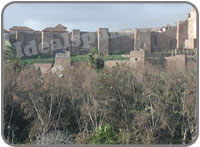
The Alcazabar in Malaga
Five
minutes
away
from
the
cathedral
is the Alcazabar,
a 15th
century
Moorish
fort.
It
will
take
you at
least
an
hour
to
explore
the
many
parts
of the
Alcazabar,
most
of
which
have
been
restored.
You
will
see
several
good
examples
of
Roman
stonework,
some
of
which
have
clear
inscriptions.
You can purchase a ticket at the entrance. On the port side of the Alcazabar there is a lift that goes to the top. There is a ticket office as you enter the lift entrance.
The Alcazabar is open every day except Mondays; summer 9.30am-8.00pm and winter 8.30am-7.00pm. |
 |
|
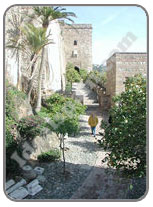 |
Pictured
left
is
another
photo
of the
Alcazabar,
note
the
pile
of
Roman
columns,
strewn
on the
path.
Entrance
to the
Alcazabar
is
very
low
and
well
worth
the
walk.
Next
stop
is the
Castle.
The
easiest
way to
get
there
is by
means
of the
number
35 bus
that
leaves
from
Paseo
del
Parque
although
you
can
walk
from
the
Alcazabar.
The
walled
corridor
that
joins
the
Alcazabar
with
the
castle
was
built
in
1333.
It is
clearly
visible
from
the
port
area.
The
castle
stands
on
Monte
del
Faro
(Lighthouse
Mountain)
which
suggests
that a
lighthouse
existed
in a
previous
period.
The
current
construction
has
been
remodelled
many
times.
All
the
same
it is
very
impressive
and
the
views
from
the
top
are
splendid.
|
The Roman Theatre in Malaga
At the
entrance
to the
Alcazabar
lies a
first
century Roman
theatre which
is
currently
being
restored. It was discovered in 1950.
|
|
| |
|
|
At the
foot
of the
hill,
next
to the
beautiful
gardens
of
Pedro
Luis
Alonso,
you
will
find
the
Ayuntamiento
(Council)
building.
Close
to
this
you
will
find
one of
the
city's
museums
in the
Palacio
de la
Aduana.
The
city
has a
wealth
of
historical
buildings,
many
of
which
you
will
stumble
across
such
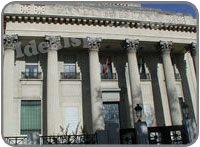
as the
Banco
Espana
building
(right). |
 |
| |
|
|
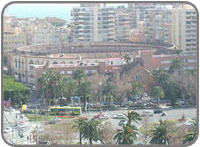
Above, The Bullring in Malaga |
Malaga
has
more
than
its
fair
share
of
squares
and
parks.
One of
the
best
green
areas
being
the
Paseo
del
Parque
that
runs
alongside
the
port
area.
Exotic
trees
cover
various
resting
places
that
hide
statues
and
water
features.
In
this
area
you
could
soon
forget
that
you
were
in a
big
city.
The
city
also
offers
an
explosion
of
culture
with
theatres,
cinemas,
museums
and
exhibitions. There is also a beautiful garden; Jardin Pedro Louis Alonso with fountains and displays of exotic plants. |
| |
|
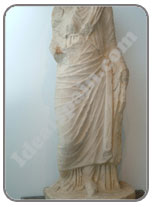
Roman
Malaga
Behind
the
cathedral
is the
Palacio
Episcopal
which
has
been
converted
to a
large
and
modern
exhibition
hall.
There
is
currently
a
fantastic
exhibition
showing
'Malaga
under
your
feet'.
There
are
numerous
rooms
containing
important
Roman
artefacts,
discovered
in the
city.
Entrance
is
free. |
Fiestas in Malaga
When
it
comes
to
fiestas,
Malaga
does
it in
style.
In the
middle
of
August,
shops
close
and
banks
reduce
their
staff
to
enable
as
many
people
as
possible
to
join
in
with
the
August
fair.
During
the
ten
days
the
city
swells
and
comes
alive
with
firework
displays
and
carnivals.
During the
day
the
festivities
are on
the
city
centre
streets
where
people
dance
and
sing.
|
By night, the centre is empty and the party has moved to the outskirts of the city in Cortijo de Torres. This is a new area that is expanding. Here artists perform and dances and concerts go on all night. The celebration program includes something for everyone, regardless of age. Even though there is a modern fair as we know it, Malaga also offers bullfights, Flamenco dances and other more traditional celebrations. Although the fair is on for ten days, celebrations start way before this and go on right to the end, until the last firework pops.
The Christmas celebrations
are
among
the
biggest
in the
province
with
more
than a
million
coloured
light
bulbs
illuminating
the
city
streets.
|
|
The Beaches of Malaga
Unusual you might imagine for a large city, Malaga also offers a long, clean beach. Each year, hundreds of thousands of holiday-makers arrive to enjoy the clear Mediterranean waters. Whatever time of year you visit Malaga, you will receive a friendly welcome. |
|
 |
Town Hall Malaga
Avenida de Cervantes, 4
Tel 952 135 000 |
Malaga University
Avda. Cervantes, 2
Tel 952 131 000 |
| |
|
Hospital Carlos Haya
Avda. Carlos Haya, s/n
Tel 951 290 000
|
24-hour pharmacy Malaga
C/ Alameda Principal, 2 (Esq. Larios)
Tel 952 212 858
|
| |
Post Office, Malaga
Tel 902 197 197
|
Education Department Malaga
Tel 951 038 000 |
| |
Universal Emergencies 112
Fire Emergencies 080
National Police Emergencies 091
Guardia Civil 062
Maritime Coastguard 900 202 202
Red Cross 915 222 222
Culture Dept 952 128 860 |
Lost Credit Cards in Malaga area
American Express Tel 902 375 637
Visa/Mastercard Tel 902 114 400
Servired Tel 915 192 100
Red 6000 Tel 915 965 335
Diners Club Tel 901 101 011 |
| |
|
|
| |
Tourist offices in Malaga
Plaza de la Marina - Tel 952 122 020
Centro Recepcion - Tel 952 213 329 |
|
| |
|
|
| |
|
|
 |
Malaga Airport
Aeropuerto de Málaga
Avenida García Morato, s/n
Tel 952 04 8804, 952 048 844 |
Malaga Train station
Estación de tren María Zambrano
Explanada de la Estación, s/n
Tel 902 240 202 |
| |
Malaga port
Puerto de Málaga
Muelle de Cánovas, s/n
Tel 952 125 012 |
Malaga Bus station
Estación de autobuses de Málaga
Paseo de los Tilos, s/n
Tel 952 350 061 |
| |
Taxi
Unitaxi
Tel 952 333 333 |
Department of Trafico Malaga
Tel 952 040 770 |
| |
|
|
| |
Arriving in Malaga by local train: The train from Fuengirola to Malaga Centro takes around 50 minutes and costs 2.85 euros each way (adults). The station is in the centre of the city, just ten minutes walk to the Cathedral. There's a tourist office as soon as you come out of the station. See a rail map here.
One of
the
best
ways
to see
Malaga
is by
means
of the
open-top
tourist
bus. A
ticket
is
valid
for 24
hours
and
you
can
hop on
and
off at
13
stops.
The
well
planned
route
takes
in 13
of the
most
important
sights.
First
departure
is at
9.30am
from
the
bus
station. |
| |
|
|
 |
Museo Interactivo de la Música
Muralla de la Plaza de la Marina, s/n
Tel 952 210 440 |
Museo Casa Natal de Picasso
Plaza de la Maerced, 15
Tel 952 060 215 |
| |
Museo Picasso
Palacio de Buenavista
C/ San Agustín, 8
Tel 902 443 377 |
Yelmo Cines Plaza Mayor
Av. Alfonso Ponce León, 1
Tel 902 902 103 |
| |
Yelmo Cines Vialia Málaga
C/ Explanada de la Estación, s/n
Tel 952 320 846 |
Teatro Cánovas
Plaza de El Ejido, 5
Tel 951 308 902 |
| |
Teatro Cervantes
C/ Ramos Marín, s/n
Tel 952 224 100 |
Sala Gades
C/ Cerrojo, junto Iglesia Sto. Domingo
Tel 951 308 902 |
| |
|
|
| |
Malaga Cathedral
C/Molina Lerio 9
Tel 952 215 917 |
Malaga Castle
Tel 952 227 230 |
| |
|
|
| |
Museo Principal Malaga
Paseo Reding, 1
Tel 952 225 106 |
Museo de Malaga
Plaza de Aduana
Tel 952 217 185 |
| |
|
|
| |
Museum of Art & Polular Costume
Pasillo Santa Isabel 10B
Tel 952 217 137 |
Malaga Car Museum
(Museo de Automoviles)
Details here |
|
|
|
| |
|
|