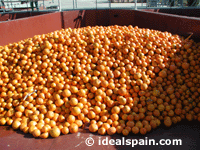
Oranges in Spain, the food of Spain
Idealspain.com
iDEALSPAIN HOME PAGE About us Contact us Forum Plan your move to Spain Advertise with us
Property in Spain
Spacer

Buying residential property in Spain

Spacer

Buying commercials in Spain

Spacer

New developments in Spain

Spacer

Golf properties in Spain

Spacer

Rural properties in Spain

Spacer

Private properties for sale in Spain

Spacer

Properties to rent in Spain

Spacer

Buy or run a business in Spain

Spacer

Advertise in properties

Moving to Spain
Spacer
In depth guide to moving to Spain
Spacer
A-Z of places in Spain
Spacer
Relocation services
Spacer
The Spanish legal system
Spacer
Taking pets to Spain
Money matters
Spacer
Basic facts about money in Spain
Spacer
Banks and banking in Spain
Spacer
Mortgages in Spain
Spacer
Investments in Spain
Spacer
Currency exchanges
Spacer
Pensions and retirement in Spain
Living in Spain
Spacer
The healthcare system in Spain
Spacer
Schools and education in Spain
Spacer
Driving in Spain
Spacer
The culture in Spain
Spacer
Live weather in Spain
Spacer
Advice for the elderly in Spain
Working in Spain
Spacer
Buy a bar or restaurant in Spain
Spacer
Working laws in Spain
Spacer
How to run a business in Spain
Holidays in Spain
Spacer
Holidays in Spain start here
Spacer
Airports and flight information
Spacer
Find a cheap hotel in Spain
Spacer
Find a cheap hostel in Spain
Spacer
Hire a car in Spain
Spacer
Golf in Spain
Spacer
Fishing in Spain
Spacer
Tourist offices in Spain
Spacer
Public transport in Spain


Exploring Spain - Oranges in Spain

Oranges are without any doubt the most important citrus crop in the world and Spain produces a vast amount.

In general, oranges in their various forms, like other citrus, thrive in semitropical regions such as Florida and subtropical regions such as California and the Mediterranean. Spain produces a variety of oranges ranging from the bitter Seville oranges to the sweet clementine.

The region that produces the most oranges in Spain is Valencia, so much so that the region has attracted the name "The Orchard of Spain". Sweet oranges are grown in well irrigated groves near the coastline. In the summer the air is filled with the heavy scent of orange blossom.


Seville oranges are large and bitter. The streets of Seville are lined with orange trees.


We were informed once by a reliable Spaniard that it is legal to pick the oranges from the trees in the streets, providing that you eat the whole orange without leaving the shade of the tree.


Sandra tried it once when visiting Seville much to her regret.


What are the different varieties of Oranges?
One interesting fact about oranges is that there are 600 types of them which are classified into three broad classes; sweet, bitter/sour and loose skinned.


Sweet Variety(Citrus sinensis): This variety is used for eating fresh, making juices and also used in tarts, salads, etc. Blood Oranges, Navel Oranges and Valencia Oranges are common sweet orange varieties. Blood Oranges are red in color due to the anthocyanin pigment present in them. Naval Oranges are large and mostly seedless, easy to peel and separate while Valencia Orange variety features none to six seeds in the carpels. Valencia variety is popular in the US, as about 50% of Florida's orange crop is this variety.


Sour Variety (Citrus aurantium): This variety is bitter to taste and is seldom eaten fresh. Cultivation of this variety is done largely in South Africa for making marmalade. However, these fruits are also exported to England and Scotland for conversion to marmalade. The juice of this fruit is used as a flavoring agent to cook fish and in parts of Egypt, it has been used for wine-making. Bergamot orange is the prominent species of this sour variety.


Loose Skinned Variety(Citrus reticulata): This variety is quite popular in India and can range in taste from sweet to tart. These oranges are part of the Mandarin family. Mandarin oranges are not really oranges, however, they come under the same genus. These are smaller in size with easily peeling skin. Clementine Orange is a hybrid of this variety, which is deep orange in color and mostly seedless. Tangerine is also a variety of Mandarin Orange and is pebbly-skinned and heavy for its size.

Related pages
 
Related articles


Whilst touring Spain we often stopped at a roadside vendor and a large bag of oranges could be bought for 3 or 4 euros. Sandra would peel the small clementine oranges and stuff them in my mouth as I drove along.

Read the latest issue now
Free Spanish Lessons  

Learn Spanish Today for FREE! Learn Spanish the interactive and fun way! Our web site will help you learn Spanish free of charge. Not just a few Spanish verbs, but over 500 words of the Spanish language, including complete Spanish phrases and sentences. Watch our free online demo that plays the first 15 minutes of a lesson. In this demo, the in program manual is displayed on the screen.

Hotel bookings more info Discount hotels in Spain Upsticks to Spain More information about this DVD
 
Do not copy
©2000-2010 Idealspain - All rights reserved
Part of the Idealspain Group of Companies