|
The
rock
of
Gibraltar
occupies
a
strategic
position
at
the
eastern
entrance
to
the
narrow
strait
and
guards
the
only
exit
from
the
Mediterranean
to
the
wide
ocean
beyond.
Gibraltar
has
been
in
the
historical
limelight
for
over
3,000
years.
4,000
years
ago
the
ancient
mariners
daren't
pass
the
rock
for
fear
of
the
currents.
The
Phoenicians
sailed
past
it
and
used
it
as
an
important
landmark,
marking
the
entrance
to
the
Atlantic.
The
Greeks
gave
it
the
name
Calpe
which
means
urn,
possibly
because
of
its
shape.
The
present
name
of
Gibraltar
comes
from
the
Arabs
who
invaded
Spain
in
the
VIII
century.
Tarik
was
the
leader
of
the
invading
army.
Since
then
the
rock
has
been
known
as
Gibel
Tarik
-
the
mountain
of
Tarik.
The
Arabic
name
has
altered
over
the
centuries
to
its
present
form
of
Gibraltar.
Tarik
did
not
build
the
Moorish
castle,
nor
did
he
found
the
city.
Both
were
built
five
centuries
after
his
death.
He
did
however
build
a
fortification
along
where
Southport
Gates
now
stand
and
up
the
side
of
the
rock.
It
was
in
1160
that
the
city
was
founded
by
the
Sultan
of
Morocco,
Abd-al-Mummin
who
built
a
castle
and
citadel.
The
first
town
was
very
small.
200
years
later
after
the
fall
of
Algeciras
to
the
Christian
forces,
the
city
of
Gibraltar
was
extended
as
far
as
Southport
Gates.
The
present
line
of
Main
Street
is
almost
the
same
today
as
it
was
600
years
ago
when
it
was
built
by
the
Muslims.
It
was
during
the
capture
of
Gibraltar
by
the
Castillians
(1309-1333)
that
the
streets
of
the
lower
town
were
constructed
and
Gibraltar
became
a
substantial
city. |

| |
|
|
It
wasn't
until
the
time
of
Cromwell
when
Britain
first
became
interested
in
the
rock
but
it
was
not
captured
until
the
War
of
the
Spanish
Succession.
Gibraltar
became
a
British
garrison
in
1830
and
was
declared
a
colony.
Spain
has
never
been
able
to
accept
the
loss
of
Gibraltar
with
good
grace
and
twice
during
the
18th
century
she
tried
to
recapture
it
without
success.
The
first
time
was
the
short
siege
of
1727.
There
was
a
more
serious
attempt
during
the
American
Revolution
when
Spain
joined
forces
with
France
in
the
war
with
a
specific
aim
of
taking
Gibraltar.
The
Great
Siege
commenced
on
June
21st
1779
and
lasted
nearly
4
years.
During
this
time
the
rock
was
defended
by
a
force
of
7,000,
commanded
by
the
Governor,
General
Sir
George
Eliott.
The
battle
eventually
ended
on
February
2nd
1783.
The
city
took
many
years
to
rebuild,
hence
the
lack
of
Moorish
buildings
remaining
here.

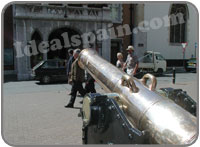
One of two highly polished
guns opposite the Convent
|
|
|
|
|
|
|
Gibraltar
has
been
a
fortress
for
centuries
and
evidence
of
this
is
to
be
found
all
over
the
rock,
from
guns
to
battlements
and
gun
turrets.
The
museum
of
Gibraltar
houses
an
impressive
collection
of
artefacts
dating
back
to
pre-historic
Gibraltar,
when
caves
were
occupied
by
the
first
settlers. |
|
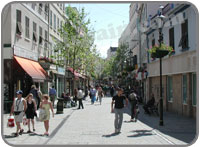
Pictured right is
a view of the
High Street, lined with tourist shops selling duty free products
It pays to
walk the High Street before you buy anything as prices and special
deals vary widely |
 |
 |
|
Learn Spanish Today for FREE! Learn Spanish the interactive and fun way! Our web site will help you learn Spanish free of charge. Not just a few Spanish verbs, but over 500 words of the Spanish language, including complete Spanish phrases and sentences. Watch our free online demo that plays the first 15 minutes of a lesson. In this demo, the in program manual is displayed on the screen. |
|
| |
 |
|