Culture of Spain -
Christmas in Spain and the Three Kings (Los Reyes Magos)
Christmas in Spain is one of our favorite times. The atmosphere can be electric. Unlike
many
other
places
in
Europe,
Christmas
lights
do
not
usually go
up
in
Spain
until
late November.
Every
town
and
city
will
decorate
the
streets with millions of lights. Christmas
markets
also
begin
to
appear.
Christmas
trees
are
on
sale
everywhere
and
gypsies
begin
to
sell
Christmas
trees
in
the
streets.
|
|
|
| |
The
first
major
sign
of
Christmas
is
the
state-run lottery which
is
drawn
on
December
22nd.
The
'El
Gordo'
(the
Fat
One)
is
one
of
the
largest
lotteries
in
the
world
and
thousands
of
people
win
each
year. Everyone wants to buy a ticket.
In
general,
Christmas
in
Spain
is
based
more
on
a
religious
theme
than
in
many
other
places.
Churches
are
packed
to
capacity,
day
and
night. Most churches have several services each day as Christmas approaches. |
| |
Christmas Eve (24th December)
Christmas in Spain, technically falls twice. You have the traditional Christmas on the 24th/25th December and the Three Kings in January. For
most
Spaniards,
there
are
three
main
stages
to
Christmas,
starting
with Christmas
Eve (Nochebuena)
which
is
very
much
a
family
affair.
The
evening
may
start
at
home
but
often
ends
up
with
a
party
in
a
hotel,
club
or
disco
with
friends
and
family.
It
is
likely
that
every
generation
of
the
family
is
represented. The party will go on all night. Cava (a fizzy chanpagne) is the most popular drink at Christmas with millions of bottles being sold. |
|
The family Christmas Eve meal is one of the most important meals of the year for a Spanish family and the housewife will be busy preparing the traditional fare for most of the day. It will consist of many courses of fish and meat.
|
|
| |
|
| Seafood is high on the list for the meal and prices tend to go through the roof at this time of year. First on the menu is likely to be plates of cold shellfish and cold cuts of meat. This may be followed by soup then baked besugo (Bream) with potatoes followed by roast lamb or suckling pig. Game is another option although turkey is becoming popular. The meal will be complemented with Cava, Spain's excellent sparkling wine. At the same time, trays of Christmas cakes and sweets will be served. The important sweets are turrón and marzipan. Turrón is a nougat made of toasted sweet almonds and has been made in Spain for over five centuries. |
| |
|
After the meal the adults will then exchange presents. The children will usually only receive a small gift. At midnight, some people will go to the Midnight Mass at the church. Others may stay at home and open a bottle of champagne to celebrate the birth of Christ. Some children go Carol singing and the youngsters may go to bed whilst the adults go out and party until dawn.
Nativity displays (Belens)
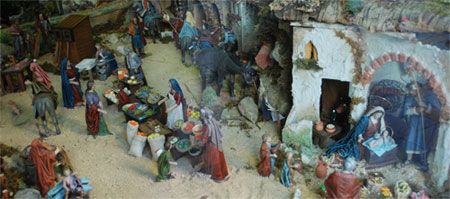
Every town and most churches will have a 'belen' which is a nativity display. Some of them are very impressive and can cover massive areas. Some are animated and illuminated and draw huge crowds. |
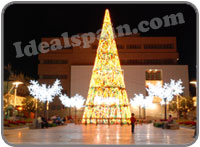
A new style of Christmas tree in Spain
- a wire frame covered in lights |
|
Christmas Day (December 25th)
This is a fiesta day in much of Spain, so all banks and shops are closed, probably to recover from the night before. Christmas Day in Spain is one of the quietest of the year. Anyone wanting to eat out on this special day will have to book well in advance. |
| |
|
The Three Kings
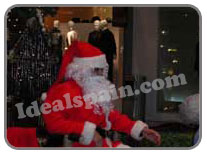
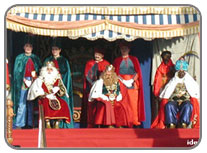
The next important day is the 6th January or Three Kings Day (Los Reyes). This is the day that the Three Kings arrived in Bethlehem, it is also the most important day for the children as the Three Kings in effect replace Father Christmas for Spanish children (although Santa is becoming popular). They arrive overnight on the 5th January, traditionally riding horses but often arrive by boat or even helicopter. The Kings will leave presents for the children during the night. Parents encourage children to write to the Three Kings with their gift requests.
|
|
| |
Every town and city in Spain will have a procession on the night of 5th January where tons of sweets will be thrown from the passing floats, much to the joy of the children (and adults). We visited Malaga to watch the Three Kings arrive by boat and Fuengirola where they arrived in a helicopter (2011). They were then part of a procession of hundreds of decorated floats that weaved their way through the city, well into the night. Most of Malaga turned out to watch them. The whole event is covered live on the local television. The atmosphere is electric. Through all our travels of Spain, we have yet to see a fiesta with such enthusiasm. On the morning of the 6th January you can only imagine the excitement of the children as they rip open their gifts.
Idealspain has produced a video of the Three Kings' arrival and parade (Fuengirola 2011), here.
|
| |

|
The three Kings are:
Gaspar has brown hair and a brown beard (or no beard!) and wears a green cloak and a gold crown with green jewels on it. He is the King of Sheba. Gaspar represents the Frankincense brought to Jesus.
Melchior has long white hair and a white beard and wears a gold cloak. He is the King of Arabia. Melchior represents the Gold brought to Jesus.
Balthazar has black skin and a black beard (or no beard!) and wears a purple cloak. He is the King of Tarse and Egypt. Balthazar represents the gift of Myrrh that was brought to Jesus. Myrrh is a perfume that is put on dead bodies to make them smell nice. |
|
|
Spain has many of its own unique traditions, all of which are great fun.
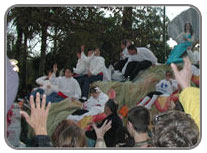
Pictured above and right is the celebration in Malaga, one of the
biggest in the country. |
 |
|
| |
|
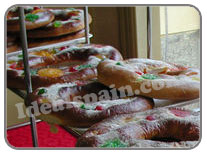
On the 6th January (Los reyes Day), a special cake is made and sold all over Spain. Roca de reyes is a ring shaped pasrty (tasting similar to hot cross buns). It is covered with sugar and fruit flavoured jellies. On biting, beware as the cake will contain plastic toys and presents. Anyone lucky enough to find one of the little gifts will be blessed with good luck all year. |
|
| |
|
Unusual traditions at Christmas in Spain
Caganer
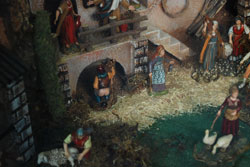
This is a Catalan speciality although seen all over Spain nowadays. The Caganer is a gnome-like figurine, usually made of porcelain. He is depicted with his trousers down, defecating and is hidden somewhere amongst the nativity scene. (spot him in the picture right). Most town halls have huge nativity displays, open to the public.
Red underwear
Although the wearing of red underwear is traditional on New Year's Eve, the little Valencian village of La Font de Figuera have gone one step further. It is tradition here to run through the street in your red underwear. All over Spain on New Years' Eve, people will be wearing red underwear. |
|
|
In the Basque country, on Christmas Eve children's presents are deleiverd by a magical man called Olentzero. He's a big, overweight man wearing a beret and smokes a pipe. He dresses like a Basque farmer.
In the Catalan part of Spain there's a Christmas character called 'Tio de Nadal' (the Christmas log) or he's sometimes known as 'Caga tio' (the pooping log). This is a small, hollow log propped up on two legs with a smiling face painted on one end. From the 8th December (the Feast of the Immaculate Conception) Catalan families give the log a few morsels of food to 'eat' and a blanket to keep it warm. On Christmas Day or Christmas Eve, the log then 'gives out' small gifts. People sing songs and hit the log with sticks to help its 'digestion' and the log drops sweets, nuts, and dried fruits. When garlic or an onion falls out of the log, all of the treats are finished for the year.
|
|
New
Year's Eve is big in
Spain and on
New Year's Eve
it is the
tradition to
wear red
underwear but
they have to
be bought for
you by someone
else. Most
towns organise
street parties
with
entertainment
and firework
displays that
last all
night. Most
bars and
restaurants
are open for
private
parties only.
There will be
music and
dancing and
the wearing of
the usual
party outfits.
At the stroke
of midnight it
is tradition
to eat 12
grapes - one
on each stroke
of the clock
to bring good
luck for the
new year. The
grapes are a
late variety
from Vinalopó
near Alicante.
We have
brought in the
New Year in
Malaga,
Marbella,
Fuengirola,
Seville and
Madrid - all
have been very
different.
|
|
|
| |
|
 |
Bargain priced Insurance for your holiday home in Spain or for your Spanish home. Policies in English and English speaking helplines. The prices are the lowest you will find anywhere |
|
|