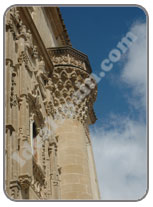
The Church of El Salvador (Capilla del Salvador)
One of the finest examples of Spanish Renaissance architecture is this church, designed in 1536 by Diego de Siloé as a family chapel and mausoleum for Francisco de los Cobos who was secretary of the Holy Roman Emperor Charles V. The many sculptures and altarpieces and the spectacular rose windows are also of special interest. |
|
|
As you
make
your
way
through
the
streets
of
Ubeda,
you
will
notice
so
many
buildings
of
interest.
On
almost
every
corner
is a
palace
of
some
kind.
Take
note
of the
Palacio
de
Vela
de los
Cobos
which
features
a
unique
corner
window
and
open
plan
upper
storey.
You
will
notice
that
Ubeda
also
has
more
than
its
fair
share
of
churches,
including
San
Pedro
which
illustrates
the
oldest
Christian
church
in the
town.
Ubeda
has a
splendid
parador
that
has
its
place
in
history
firmly
staked
out.
You
can
clearly
see
Ubeda
in the
Middle
Ages.
The
original
building
is of
the
16th
century
and
this
palace
was
converted
into a
parador
in
1930.
Even
in
1930,
before
the
tourists
began
to
arrive,
the
parador
was
equipped
with
central
heating
and
the
bathrooms
had
hot
and
cold
water.
In
1930
it
cost
just
35
pesetas
per
night
for
full
board.
The
history
of
Ubeda
is
varied
and
the
Arabs
were
the
first
to
write
the
history
of the
town
in the
8th
century.
The
Moors
also
brought
their
customs
and
knowledge
of
astronomy,
medicine
and
music.
Throughout
history,
Ubeda
has
seen
many
battles
and
conquests
from
the
arrival
of the
Moors
to the
reconquest
when
the
Christians
finally
drove
them
out.
The
Catholic
kings
came
here
after
the
conquest
of
Granada,
in
particular,
the
Queen
came
here
in
1484
and
stayed
for
several
days
at the
Santa
Clara
Convent.
Ubeda
offers
many
local
handicrafts
including
hand
embroidered
mats,
illustrating
Moslem
craftsmanship,
hand
made
pottery
and
iron
work.
When
it
comes
to
cuisine,
Ubeda
is
quite
simple.
Nobody
claims
that
the
food
here
is
exquisite
or
even
unique.
When
asking
a
local
about
the
food,
he
replied
'basically
bread,
oil,
some
game,
a
little
fish,
something
from
the
vegetable
garden
and
whatever
we can
do
with
it'.
The
town
does
however
yield
a few
local
surprises.
Simply
walk
into a
restaurant
and
ask
for
the
local
speciality.
From
Ubeda,
take
the
321
highway
and
explore
Baeza,
an
important
place
even
in
Roman
times
and
now a
lovely
stopping
place
with
several
pleasant
squares
and
monuments.
From
Ubeda
you
can
also
explore
more
than a
dozen
tiny
hamlets,
steeped
in
Arab
history.
|