|
|
Places in Spain - Italica, Roman city in
ruins
Italica
was founded in the year 206BC by General Publius Cornelius Scipio as a
place of settlement for soldiers wounded in the battle of Illipa. It also
served as an important military outpost. The name Italica gave reference
to the first settlers who came from Italy.
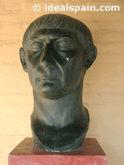
Marcus Ulpius
Trajan was born in the city in 53AD as was his successor, Aelius Hadrian
in 76AD. |
|
|
 |
| |
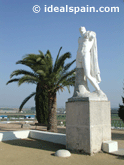
Located
just a few miles north of Seville, in the
village of Santiponce lies one of the most important and largest Roman
ruins in the whole of Spain. The Roman city of Italica demonstrates wonderful
examples of Roman architecture, mosaic work and city layouts.
Italica
can be visited every day except Mondays and entrance is free for EU citizens.
Otherwise, entrance costs just 1.5€. Group visits can be arranged
in advance. Pick up a guide book from the kiosk as you enter the city. |
 |
|
|
|
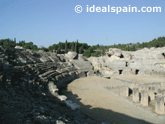
The
massive amphitheatre, one of the largest in the Roman Empire, surrounded
by a wooded park, is one of the most impressive we have seen. It is also
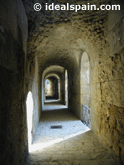
in reasonably good condition. You can wander through the tunnels where gladiators
would once have walked and stand in the den which would have housed the
lions. The theatre had a capacity of 20,000 spectators that sat on the three
tiers. In the centre of the arena is a great pit which would have been covered
by a wooden structure. This was used for gladiator and wild animal sports. |
 |
|
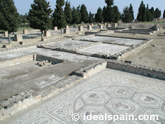
| The
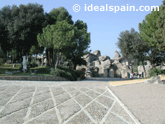
streets are characterised by their great width and even today, the original
cobbles and guttering remains. The street layout is of a grid pattern, forming
regular squares in which would have stood public buildings and private dwellings.
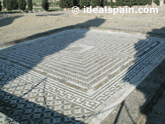
Several of the buildings have been uncovered to reveal intact and well preserved
mosaic floors. |
 |
Italica
can easily be distinguished into two zones. The vetus urbs (old
city), founded by Scipio and the nova urbs, founded by Hadrian.
The vetus urbs now lies deep beneath the village of Santiponce but the
nova urbs is here, on display to the visitor in all it's glory.
Excavations
of Italica date back to 1781 and have not stopped since. It is estimated
that the city is so large that excavations will never be completed. |
 |
|
The city
was provided with fresh water by means of an aqueduct and the waste water
was taken away by means of underground drains. Some of these can still
be seen through grilles placed at the road intersections.
Some of
the houses uncovered include the House of the Planetarium with
it's hexagonal mosaics depicting the seven Gods that gave names
to the days of the week. The House of the Birds, partially restored
to show what it may have looked like and the House of Neptune with it's
warm thermal baths.
In July,
Italica comes to life with the hosting of the International Festival of
Italica. |
|
| |
 |
 |
| |
| |
| |
|
|
|