Road classifications and speed limits in Spain
Autopista (motorway) - A
or E - prefix
to road
number: these
can be toll
roads (peajes).
Maximum speed 120 kph (73 mph)... example, AP7 or E90
Autovia - dual carriageway, not necessarily with a central reservation.
Speed limits vary from 80 to 110 kph .... example A8
Carretera Local -
highway.
Speeds are as
signed, but
usually not
more than 100
kph
Carretera
Nacional -
N or CN -
prefix to road
number, main
roads. 100 to
60 kph .... example CN322
Local small roads are often CV roads
Please note
that the
speeds are
somewhat less
for various
classes of
vehicles
including
towed
trailers/caravans
A FEW HINTS for driving in Spain
Traffic lights
The
traffic-lights
(semaforas) in
Spain are more
often than
not, situated
only at your stop
line for the
junction and
so you can see
when they
change when
you are in the
front of the
queue, there
is a set of
smaller lights
on the support
post. An amber flashing light means that there is a hazzard approaching, such as a crossing. You can pass through this light, with caution if clear to do so. Sometimes you will come accross an amber light and if you pass through at more than the speed limit, this will change the next lights to red, meaning that you have to stop.
Pedestrian crossings
The Law for
pedestrian
crossings
until recently
is not as
strict as in
for example,
the UK where a
driver is
always at
fault if the
vehicle hits a
pedestrian on
the crossing.
You must step
onto the
crossing,
remembering to
look LEFT, and
show the palm
of your hand
to any
approaching
vehicles.
Previously,
they still did
not have to
stop, but a
new Law
involving
penalty points
means that the
drivers can be
penalized now
for not
stopping. Many
tourists are
injured, some
killed each
year, for only
looking right
when crossing
the road.
Overtaking
You may NOT
overtake on
the right
(inside lanes)
on the
highways
unless there
is a slip road
or another
road indicated
and you are
taking it. I
know this is
the same
elsewhere in
the World
where bad
drivers insist
on cruising in
the middle
lanes. However, it is very common in Spain to be passed on both sides of you so be aware when shifting lanes.
A FEW BASIC
RULES
Give way to
traffic from
the right
unless
otherwise
signed. On
roundabouts you give way to the left unless signposted different.
Do not pull
into the
middle of the
road to turn
left if there
is a solid
line in the
road. There
are often
special lanes
for this,
signposted cambio de
sentido (change of
direction),
especially on
the autovias.
Seatbelts
It is
compulsory
for all in
the car to
wear
seatbelts,
both front
and rear
where
fitted. The
driver is
responsible
for any
fines
where
passengers
are not
wearing an
approved
belt.
Children
under 12
years of
age are
not
allowed in
the front
seats
(unless
they are
over 150
cm or 4
ft. 9 ins,
then they
can unofficially get away
with it.
It is
apparently
to do with
being
secure in
the safety
belt).
Also, if
seated in
the back,
the belt
must fit
correctly,
or a
special
“raising
seat” must
be fitted.
Animals
must be
restrained
when in
the
passenger
section
and not
allowed to
jump
around.
Drinking and driving (see more info here)
Do
not drink and
drive - the
limits are
about half
those in the
UK and the
penalties very
high including
losing your
licence on the
spot, boosted
by the new
“rapid
justice”
Courts, as are
heavy
on-the-spot
fines for
traffic
offences. You
will not be
allowed to
leave the area
until you have
paid any fine
or appeared in
Court,
including
spending time
in the cells
if you cannot
pay in cash.
Update courtesy of Andrew Marshall
I think it would also be useful to point out another very important difference from driving in Britain, whcih is the "hierarchy" of traffic signage. At many large junctions, there are traffic lights AND a stop sign, which seems confusing and in Santander and Bilbao I often see drivers of British registered cars dithering and hesitating - quite naturally, as very few websites or official guide books actually point this out and it is not intuitive!
In fact, the STOP sign comes into force if the traffic lights fail or operate as flashing amber (which is sometimes the mode used at night).
Thus a uniformed traffic police officer has priority over all signs (as in Britain) and the traffic lights come next in the pecking order; then "vertical signs" (e.g. a STOP sign on a pole) and finally, a "horizontal" sign such as a STOP line on the road surface, usually faded and very often invisible.
There is also a little known rule obliging a motorist to stop at the scene of an accident and give assistance as necessary (bare minimum is to call 112, where it is possible to obtain an English speaking operator); although there was in the past an obligation to ferry an injured person to the nearest first aid post, current best practice advises against this owing to likelihood of spinal injuries etc.
However, failure to assist a person in danger is a criminal offence, unlike in Britain where it is perfectly legal to stand and watch someone haemorrhage to death!
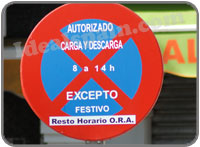
Parking in Spain
As a general
rule you may
not park in
Spain where
the pavement
curb is
painted yellow
or where a no
parking sign
is displayed.
In major
cities and now
even the
villages,
non-metered
on-street
parking is
difficult to
find but in
some areas,
there are
parking spaces
marked in blue
for which you
should
purchase a
ticket from a
nearby machine
on the
pavement
usually topped
with a blue
and white “P”
sign, or from
an
attendant. These
spaces are
usually for
about two
hours maximum.
Penalties for
parking
infringements
vary from town
to town and
can be heavy. *On the Costa del Sol at least, a parking fine in a blue bay is around 3 Euros.
| |
|
| It helps if you have a basic understanding of road signs in Spain. See a selection of common road signs here |
|
| |
|
Driving a foreign vehicle in Spain
If you
park
illegally,
especially
in a
foreign
car, you
will
almost
certainly
become a
victim of
the 'grua'
- the
local tow
truck, and
if you
suffer
this,
there
should be
a sticker
left on
the curb
with the
phone
number/address
of your
car’s new
location.
Getting
your car
back will
be a
hassle and
will cost
you dearly
in fines
and fees,
not to
mention
the
possible
problem of
your not
speaking
Spanish.
Where
possible,
look for
underground
parking
with
security
attendance.
its worth
paying
that
little bit
more. Collecting your car from the grua is no fun. You go to the compound and pay the recovery fee. Then you go to the police station and pay the fine. Then you return to the compound with your receipts and get your car back.
You will
note
however,
despite
all this
advice,
the
Spanish
will park
wherever
their car
happens to
come to a
halt, even
on
crossings,
pavements
and
roundabouts,
but the
new 2005
Laws now
mean that
penalty
points can
be given
to parking
transgressors.
|
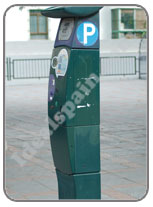
Pictured left is a ticket machine for pay and display parking in blue bays.
Easy to use - simply insert coins until the departure time you want is displayed on the machine. Press green button for ticket and display in your windscreen.
If you have a parking ticket fine you can pay it with this machine. Insert the ticket into the envelope you have been given, along with cash payment. Then put into the letter box in the machine.
Normally parking is free on Sundays, bank holidays and every day between 2pm-5pm but read each machine carefully. |
Fines for motoring offences in Spain
New fine
rates have
recently
been
published,
and over
set limits
in each
location (autopista,
town,
etc.) you
can be
arrested
on the
spot. You
are not
allowed to have a
radar
speed
detector
in your
vehicle,
let alone
use one.
Speed
traps are
becoming
quite
frequent
but not as
bad as in
the UK
with
cameras
(yet; the
salesmen
are moving
in). Fines
for other
offences
are
calculated
on the
severity
of the
offence
and there
is a table
for the
guidance
of the
police and
Courts.
If you are
a tourist
without
assets in
Spain, all
fines are
payable in
cash “on
the spot”.
The legal
drink-drive
limit is
currently
0,5
grammes
per litre
of air
using a
breathalyzer. The
very high
death
rates in
Spain (in
the top 3
in the
“old” EU)
means that
if caught
with
excess
alcohol or
drugs in
your body,
you can
expect to
lose your
licence
(in a
special
Court,
possibly
that same
day) or,
if a
resident,
have to
attend a
special
school.
A common fine currently being issued is for not having lights on when it's raining. The fine is around 200€.
Road
tax and
vehicle
inspections (see about the Spanish ITV here)
If you are
using your
foreign
registered
car in
Spain for
a few
months (no
more than
six months
in any
calendar
year is
allowed)
then it
must be
legal as
far as
roadworthy,
insurance
and road
taxes are
concerned. You
cannot get
your car
MOT'd in
Spain, or
even in
Gibraltar,
and if the
certificate
runs out,
not only
will you
be illegal
in Spain,
but also
as soon as
you arrive
back in
the UK.
Spanish
vehicles
have to
conform to
inspections
also,
depending
on the
type and
use of the
vehicle.
UPDATE: October 2010: The Spanish police are now cracking down on all foreign vehicles driving around in Spain. If you are caught using a UK vehicle in Spain whilst living here, you will at the least, have your vehicle impounded. Fines are being handed out in the region of 2,000 euros. Having no UK road tax on your vehicle invalidates your insurance.
Toll/Peaje
roads in Spain and how to use them
Spain has
over 2,000
km of toll
roads and
more are
planned.
They are
of
excellent
standard
and all
have
service
stations
with cafes
of an
acceptable
standard
every 40km
or so. The
tolls are
expensive,
especially
in summer
when the
rates are
doubled
and are
usually
calculated
per km.
Some toll
roads, for
long
distance
travelling
allow you
to collect
a ticket
at the
start and
then pay
the total
when you
exit the
road. They
do however
mean that
you can
drive
relaxed and safer
over long
distances
as the
locals
usually
avoid
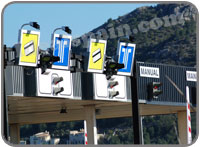
them. Most ticket booths are on the left so in a UK car, the passenger will need to ttake the ticket/pay. Some booths have operators both sides.
|
As you approach the ticket booth or entry to the toll road, carefully make your way into one of the lanes and take your ticket/pay. When you come off the toll road and need to pay, watch the lanes carefully as all the lanes are different. 'Manual' is where the operator will take your cash, 'Automatic' is a machine only where exact money can be paid. 'Tarjeta' is to pay by credit card only. |
Mobile telephones in your car in Spain
The use of a mobile telephone, other than a true hands-free, whilst driving is now banned in Spain, even at the side of the road. You have to pull off the road completely away from any traffic. You may also not have any device in your ears to listen to music or your mobile phone etc., only allowed is something for enhancing your hearing, i.e. a deaf-aid. Sadly, you still see erratic driving where a mobile is in use, but penalty points and fines can now be awarded.
Navigation aids and DVD´s etc.
This is a grey area of the law. Some say these aids are illegal yet they are now commonplace. I personally was one of the first in Spain to have such a device and used it for 8 years with no problems. Indeed once the police stopped me and were fascinated by the device.
The driver must not use any screen based aid to navigation (or entertainment) while on the road. You must pull completely off away from traffic. (It makes sense really; after all, you are not allowed to drive down the road with a map on the steering wheel). DVD players and screen based devices other than those directly needed to operate the car must be positioned so the driver cannot see them. However, in reality, the police rarely have anything to do with this law.
Speed trap detectors
You are not allowed to have a radar speed detector in your vehicle, let alone use one.
Towing a trailer in Spain
According to the Guardia Civil, you can tow a trailer in Spain subject to certain rules. Your vehicle towbar is inspected as part of your ITV (MOT). You need to produce a fitting certificate. There is no charge for the inspection, on top of your ITV fees.
Up to 750kgs:
- Needs Ficha Technica and ITV.
- Does not need its own registration*
- Does not need its own insurance*
* Unless run for business use.
Over 750kg:
- Needs its own registration and red licence plates.
- Also needs the plates of the vehicle towing it clearly on show.
- Will need its own insurance.
- Subject to road tax also.
Losing your licence
If you are stopped by the police or interviewed at the scene of an accident and you are showing signs of being incapable of driving the vehicle for any reason, the police are empowered to immediately take away your driving licence and you could lose it if found in breach of the Law. There are laws affecting penalty points that are different (more restrictive) for new drivers. The Spanish government is determined to reduce the high accident rates on the roads. NEW LAWS dictate that if you are caught driving without a licence it is classed as a criminal offence and not a driving offence and you will face an immediate 6 months in jail.
Motorcyclists in Spain
Moto’s, as motorcycles are called in Spain, are subject to the same Laws as other road users, including the reflective jacket rule, which has to be worn by law if you dismount the bike and stand on the highway. However, wearing a hi-vis jacket could make you more visible to other motorists and reduce the chance of a collision. The headlight must be on dipped setting during the day, and an approved crash helmet must be worn, properly fitted and secured, at all times while riding. Penalty points can be awarded for transgressors. Otherwise, the Laws are similar to other EU countries.
Spanish plates (full feature and samples here)
We get lots of E-mails from people wishing to put Spanish number plates on to imported cars. The general advice is, for right hand-drive cars, unless the car is a classic or is special to you for sentimental reasons, DO NOT BOTHER. It is better to sell it in the country of origin, or arrange to swap it with someone returning there.
If it is a motor-home or a medium to large right-hand drive commercial vehicle, you will not be allowed to anyway for safety reasons.
If you are coming from a left-hand drive EU country, then it is not so difficult, but unless you speak Spanish, use the services of a gestor or registered business advisor. It will save you a lot of sweat and heart-ache.
|